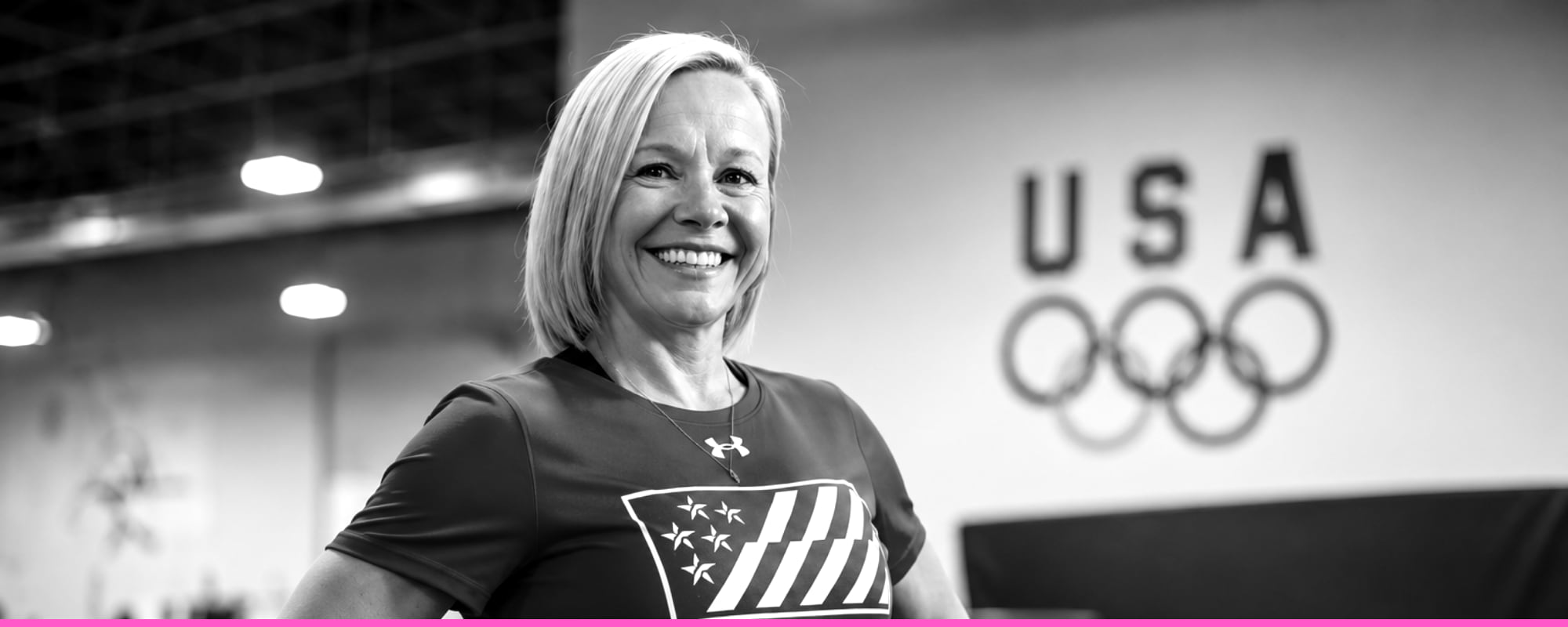
Twenty-two years of running her own program taught the Olympic captain that hard work and joy were never the trade-off everyone assumed. Here is how she builds it, and what it looks like from the viewing window.
Amanda Borden went to college to be a teacher. She started with math.
"I got talked into running a gymnastics camp at the school and then run the after school classes," she told The MedGym Podcast. "And then I realized, like, I can actually just teach my favorite thing in the world."
Gold Medal Gymnastics opened without a competitive team, without an elite plan, without much of a plan at all. Recreational only, boys and girls, for the first year or so. Twenty-two years later Borden coaches the Level 9s and 10s at two Phoenix-area gyms, in Tempe and Chandler, and her daughter Kennedy came up through that program. She'll compete for Alabama next season.
Ask her what a healthy gym looks like on an ordinary Tuesday and she starts with something a parent can actually see from the viewing window.
"It's bright, it's colorful, fun music," Borden said. "The body language of the adults in the building is very important. So that feel."
She uses one word more than any other.
"A big word in my life that I use a lot is joy."
Borden is aware of how that sounds coming from someone who won an Olympic gold medal, and she is direct about what it is not. It is not the absence of standards.
"I'm really striving to teach kids that whatever your goal is, like you can do hard work and you can do it with joy. You can have fun doing it."
She traces her own version of it back to being coached that way.
"Because I was raised in this type of environment as an athlete, it almost seemed normal, like, this is what everybody experienced," she said. "And what I started to realize is that as I hired coaches, I was like, huh. Okay. Well, not everybody experienced it like this."
That is the harder half of running a gym. The kids are teachable. The adults arrive already formed.
"We all come to the sport as coaches with very different reasons, backgrounds, knowledge, et cetera."
The tell of a good program, in Borden's telling, is a coach who will abandon their own method.
Athletes transfer in from other gyms. Some arrive with a different idea of what training is supposed to feel like.
"Yes, there is this system in my mind that I know generally works to get you these skills and then put them together in routine," she said. "But if I'm so set on that one system, I'm not being a great coach or teacher. And so that system takes my communication and ideas and yours as the athlete."
The same standard applies to her staff.
"We all bring in a strength. We all bring weaknesses. And if we're not working together, like setting our own egos aside and working together to better the child, the program, the situation, then we're failing."
This is where positive coaching stops being a philosophy and becomes a clinical decision, and it is the part Borden has thought about hardest.
Her first move is not to talk to the athlete.
"My first choice is to build a relationship with their doctors and PTs," she said. "I teach the kids right from the get-go that I'm not the doctor or the PT. I've obviously been involved in this sport a lot, and some of these injuries I've had myself. And so I know a little bit about it, and I have a general idea of what I think I would recommend for a return to certain things, but your PT is gonna know best."
She also names the failure mode from the other direction, which as a physical therapist I will admit is the one that keeps me up.
"If you have a PT that doesn't necessarily understand the sport, they sometimes will say, 'You're good to go.' And I'm like, good to go? We haven't done a run or a jump on anything, let alone on a hard punching surface with force and body weight and power."
A wrist cleared is not necessarily a wrist cleared for bars. That distinction has to be taught, and Borden teaches it as a conversation rather than a rule.
"We have kids that are like, I'm allowed to do bars. Great. So I kind of come up with the plan, but they don't want to do any what I consider bar conditioning. And I'm like, well, let's review this. If I let you do the gymnastics and we don't ever do the conditioning or the flexibility, then I'm just setting you up to get injured again."
Her reasoning is mechanical, and it is correct.
"Conditioning, in my opinion, is a much more controlled, slower paces, not as much force. A lot of times it's just a handstand, we're holding your body weight. We're not jumping back to the handstand, which is more than your body weight."
Borden does not pretend the honest version of this is easy.
"The struggle, because I don't want to act like this is easy, is getting sometimes all the truth from the kids, as far as what they can and can't do, but also their pain. And then also parents."
Parents are not villains in her account. They are under a clock.
"Quite often they're overlooking some of it because they want to make sure their kids can get in to compete. We only compete in this small window and it's now or never. And so there are these other pressures."
The answer she has landed on is substitution rather than subtraction. One of her gymnasts had a bad shoulder, and bars was one of her best events.
"She was devastated to not train the same way because she saw that this training plan works and she was very successful and she liked that feeling. And so we had to come up together with a plan."
"So you're not doing say ten full outs, but you're doing this drill, that drill, and this drill, which equals ten full outs, but you didn't even hurt your shoulder."
Visualization is a real part of the ledger, not a consolation prize.
"You can do five full bar routines in your head and have bloody hands that day, couldn't even swing, and you still gained something out of this."
And the moment she is chasing is the moment the athlete works it out for herself.
"One of my favorite things is watching an athlete finally go, like, that does work. I don't have to do the full routine. Or, I can do my beam routine down here on the laser beam because I just don't feel right today, and I just got so many perfect reps that I almost feel better."
For a parent watching a ten-year-old fall in love with this sport, Borden's advice is not about gyms or levels or timelines.
"Walk alongside your kids, because there's nobody that loves them more. But start teaching them how to think about what they want and what that might take."
Teaching them how to think about it is a formal part of the week at her gym, an hour her upper levels spend building goals rather than training them. That method is worth its own read.
She did not coach Kennedy herself until Level 8. She stayed at bars until Level 9 and 10, then took bars and beam: the two she considers hardest mentally. When it got sticky, she handed her daughter to another coach on purpose.
Kennedy's assessment of her mother's coaching style is on the record.
"Mom, you're too nice. You're too positive."
The line Borden set for herself was somewhere else entirely.
"I always said from the beginning, there's nothing she'll ever accomplish as a gymnast that's more important to me than our relationship."
Read next: Amanda Borden on the Magnificent Seven at 30