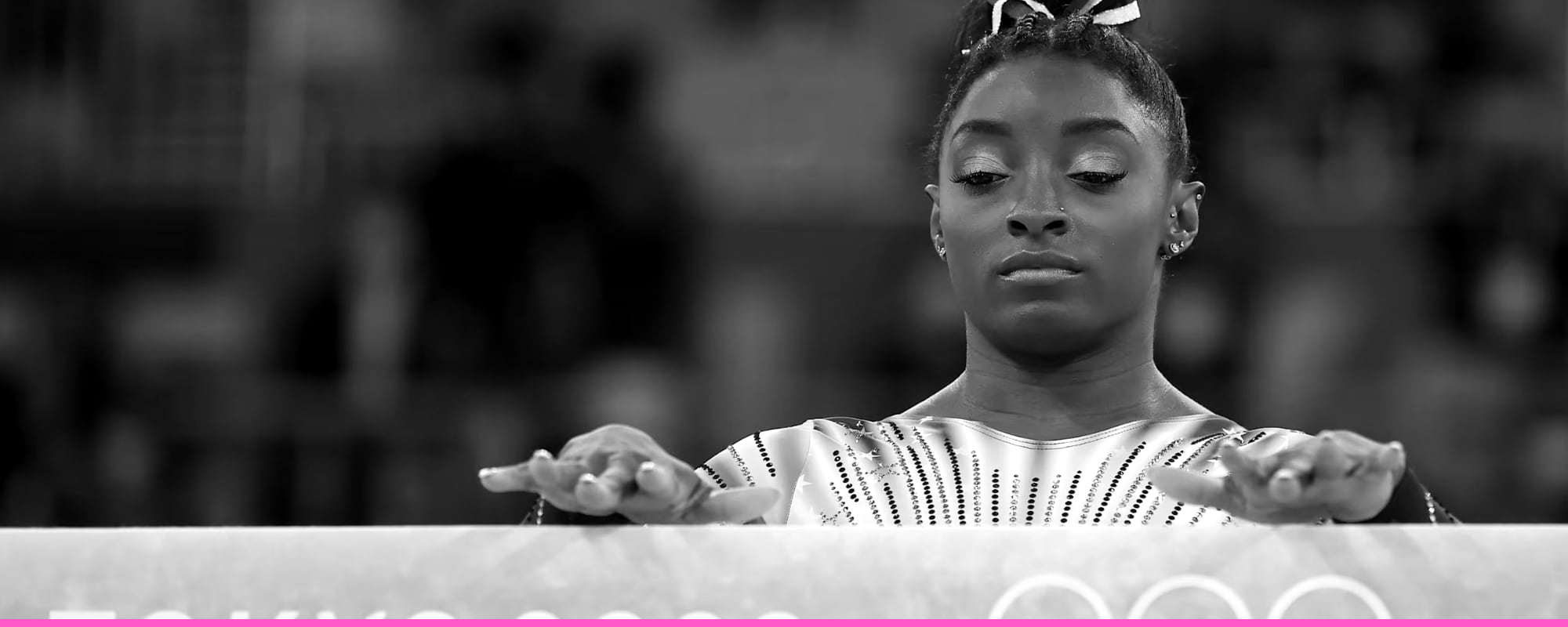
The anatomy, the physics, and the human being: an explanation of the condition that stopped the greatest gymnast of all time mid-air at the Tokyo Olympics.
After explaining this nearly a hundred times in 72 hours, to friends, peers, coaches from other sports, medical professionals, and even news stations, it feels important to actually walk through the physiology of what happened in Tokyo. During qualifying, the world saw something it almost never sees from Simone Biles: a major error on vault. Instead of the two-and-a-half-twisting Amanar, she lost her air awareness, opened early, and landed hard after "only" a one-and-a-half. She later named it: the "twisties."
For the full picture, two companion reads help: my earlier pieces The Physics of Simone and The Layer of Fear, both for Inside Gymnastics.
The "twisties" are the sudden inability for a gymnast to make the requisite spins, or sometimes any spins, for a particular maneuver. For some, it's the opposite: the urge to twist on a skill that has no twist. It is not simply dizziness. Dizziness lives in the vestibular system: the inner ear, vision, and how the brain filters and computes that input to decide where you are and how you're moving through space. Even astronauts get dizzy. What matters more in gymnastics is how the athlete takes in that input and responds to it, and how frightening that becomes when even one variable (an inner-ear issue, poor sleep, vision that's slightly off) is not quite right.
The simplest version: proprioception is knowing where your body is in space, so you can tell you're upright or leaning left with your eyes closed. Kinesthesia is one step further: knowing the speed at which you're traveling (spinning, flipping, rising, falling) from motion, vision, sound, and the feel of air on the skin. A multisensory, non-stop barrage of feedback.
The central nervous system is constantly talking to muscles, tendons, ligaments, and joints. Mechanoreceptors and neuromuscular spindles sense when a muscle lengthens or shortens; Golgi tendon organs, where muscle meets tendon, sense stretch and pressure. On vault, an athlete can feel from how much the wrist flexors stretch on impact whether they're high on the table. On beam, the eyes register whether the body is square. These signals travel at 70 to 120 meters per second (thousands of times faster than asking a question and hearing an answer) and it all happens without conscious thought.
The right response is called neuromuscular control: not overcorrecting, not undercorrecting. Layered on top is "air sense," a form of proprioception specific to the air: knowing your twist speed, your height off the vault or in tumbling, your turnover rate on release moves, the verticality of a handstand. Knowing your cast was too hard and you'll have to control it at the top, or tip over. Knowing when to prepare for the ground on a dismount.
"Literally cannot tell up from down. It's the craziest feeling ever. Not having an inch of control over your body. What's even scarier, since I have no idea where I am in the air, I also have no idea how I'm going to land. Or what I'm going to land on... head / hands / feet / back."
Simone Biles
For most athletes, nothing is more stressful than the Olympic Games. Stress raises cortisol, and elevated cortisol changes how the body regulates everything above. There's also the problem of paired sequences: because so many entries and directions of rotation happen in the same practice, sometimes the same tumbling pass, the body can get "stuck." An age-group athlete learning a full-twisting back often struggles to then simply flip without twisting. A Yurchenko double can bleed into an Amanar. The body gets used to what it repeats.
We also see the mid-air disconnect elsewhere: divers who hit the water horizontal, risking blackouts and concussions; figure skaters whose blades slip on landing; aerial skiers who get far higher off the ground than any gymnast. Athletes test their air awareness constantly (a standing back tuck, a high layout) just to check that the system is online.
There is no single timeline, and forcing one backfires. What works for one athlete may not for another. The point is that recovery is individual and, done right, a partnership between the athlete, coaches, and medical team. Approaches include:
The athletes who come back do it on their own clock, with a team around them. That is the whole point of treating the gymnast as a human first: the fastest way back is almost never the most forceful one.