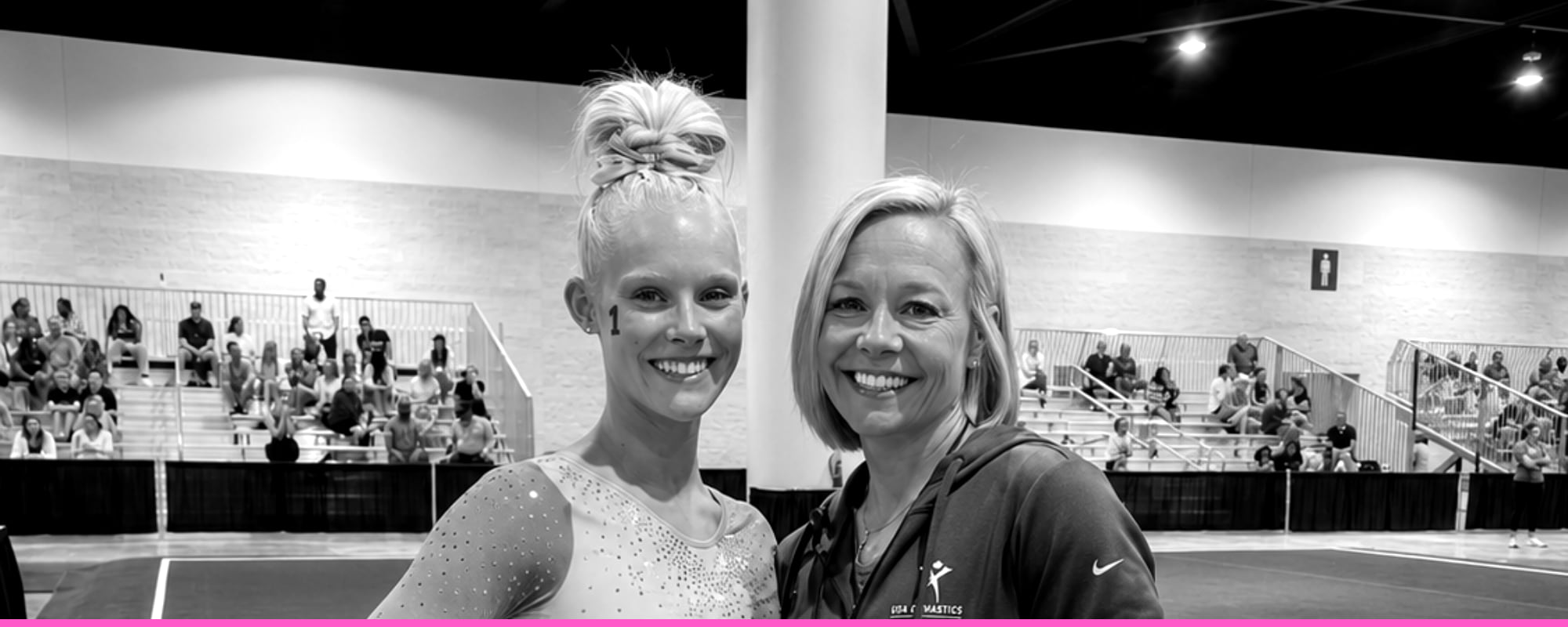
The Olympic captain noticed her gymnasts could name a dream and not a next step. The fix she built turned out to have the same shape as a rehab protocol.
The gymnasts can all name the goal. That has never been the problem.
"I have a lot of kids that have big goals and big dreams, but putting that into productive actions right now is what I'm noticing they're struggling with," Amanda Borden told The MedGym Podcast.
Once a week at Gold Medal Gymnastics, the Phoenix-area program Borden has run for 22 years, the upper-level athletes stop training and sit down for an hour. She calls it Empower Hour. They have worked through books. They have brought in mental performance coaches over Zoom. Borden leads most of it herself.
The core exercise is goal-setting, and she breaks it down further than most programs bother to.
The first thing she found was that her athletes had no working sense of scale.
"Their telescope literally could be December for competition, or it could be ten years from now," Borden said. "Like, they think anything past today is long term."
So a Level 8 chasing a college roster spot and a Level 8 chasing a meet in eleven weeks were doing the same thing with both: naming it, wanting it, and then going to practice.
"We were noticing kids were really struggling with, okay, even if my long term is three months away, what's my next step today?"
Between the telescope and the microscope, Borden builds a ladder. Monthly check-ins on the rungs. Daily assignments she calls baby steps.
It only works if the rungs are real, so she makes the athlete build them backward from the skill.
You have a Yurchenko pike. You need a Yurchenko full or better. The vault in between is a layout. What gets you the layout, and what part of that can you touch today?
"You can't do the Yurchenko one and a half today," Borden said, "but you can work on your run, which does include your lunges and your power skips or your hops."
That is the whole method. A ten-year goal is not actionable. A run is.
The part that separates this from a worksheet is that Borden refuses to fill it in.
"I probably have a hundred things I could tell you to try to give you a baby step chance," she said. "But the point is to not just do my checklist. The point is helping them learn how to create a process to help them move forward, because ultimately it doesn't matter what you're moving forward towards."
She wants them to invest in the process, and thinking it through is the investment. If an athlete cannot come up with ten steps of her own, the assignment is not to come ask Borden for them.
It is to go find someone who can help her build them. That is a rung too.
This is where it stops being a coaching philosophy and starts looking familiar to me.
A return-to-sport protocol is a ladder. The mistake almost everyone makes with one is reading it as a calendar.
Twelve weeks does not earn an athlete a run. Establishing hip control, alignment and the quality of the step before it earns her a run. If I write out a progression for an ACL or an Achilles, the rungs are criteria, and the dates are a rough guess about how long meeting the criteria usually takes. Athletes and parents read the dates. The dates are the least important thing on the page.
Skill acquisition works the same way, and this is where coaches and clinicians are usually saying the same sentence in different vocabularies.
A switch ring worth competing on beam is built on a flat split, then an oversplit, then an arched split with a bent knee, and each of those was a rung somebody had to climb months or years earlier. When a Level 9 asks for the switch ring now, the honest answer is that she needed to have started working on it two or three years ago.
Every August, I hear from someone who needs a back handspring for cheer tryouts on Thursday. Nobody has ever learned a back handspring in three days. Even if I did not care whether she got hurt (and I do), the tissue would not cooperate.
The ladder is not a motivational device. It is a description of how bodies actually change.
Borden used the same framework on the largest decision her daughter has made so far.
Kennedy Cochran came up through Level 10 in her mother's gym and will compete for Alabama next season. Before any of the recruiting calls started, the question was not which schools.
"Before you even do any of these calls, what is most important to you?" Borden said. "So that when we say, well, here's why you like this school, does it answer the why you originally started with?"
Kennedy's answers were the things she had grown up inside: culture, positivity, a team that wanted to win as much as she did, and the relationships, with the coach, with the team.
Borden says her daughter never ran on a single track. She wanted to be an elite gymnast at one point, thought about the Olympics, changed her mind, and stayed loose about what the plan looked like while keeping the conversation open.
Which is the point of building the ladder rather than being handed one. The rungs change. The method does not.
"You're gonna know by the conversations and asking questions that are meaningful to you," Borden said. "And you're gonna know when you go on these visits, because you're going to be able to see, do these things look like what you talked about prior to knowing any of the inside scoop?"
For a parent watching a ten-year-old fall in love with this sport, that is the whole of Borden's advice, and it has nothing to do with gyms or levels.
"Walk alongside your kids, because there's nobody that loves them more. But start teaching them how to think about what they want and what that might take."
The plan is not the deliverable.
"It's create it and actually do it."
Read next: Positive Coaching in Gymnastics: What Amanda Borden's Gym Sounds Like