Transcript
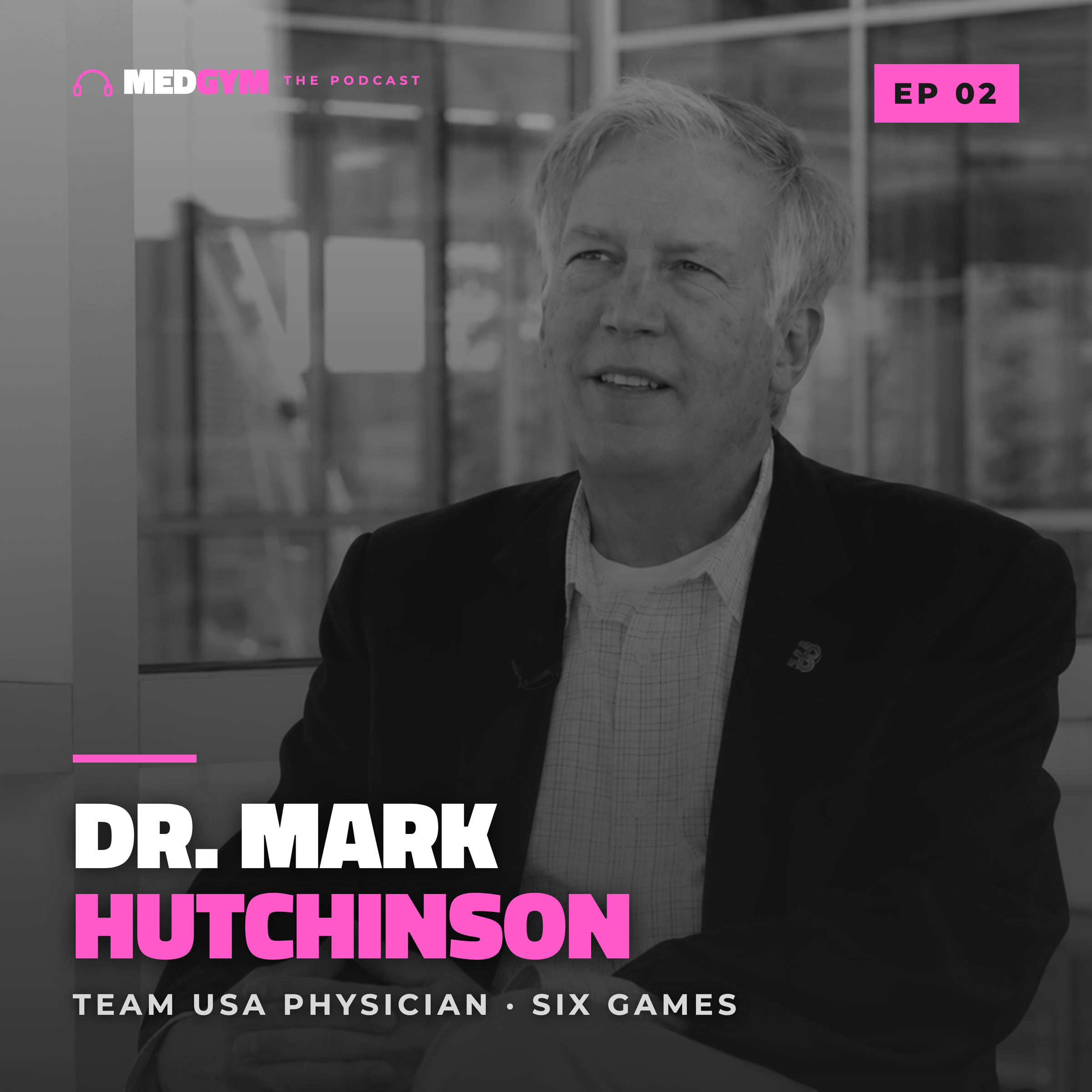
Gina Pongetti: Hello everyone and welcome to the MedGym podcast. I'm Gina Pongetti Angeletti, physical therapist, and someone who has spent a career in the gap between what an athlete's body can do and what it's being asked to do. The show is about health in the sport across three pillars: mental, physical, and training. When you watch a gymnast land badly, the camera goes to her face, mine goes to the edge of the mat, to the people already moving. Who have about four seconds to decide what happens next. Sometimes that's me, and sometimes that's our peers. My guest today has been one of those people at six Olympic and Paralympic Games. Dr. Mark Hutchinson is a distinguished professor of orthopedics and sports medicine at the University of Illinois Chicago in our hometown here, the head team physician for UIC Athletics. His first games was Atlanta in 1996 as head team physician for USA Gymnastics National Rhythmic Team. As we are celebrating 30-year anniversary of our artistic team winning gold, he and I were reminiscing about 30 years ago and how it seems like just yesterday. He's been at Torino, Rio, Tokyo, Beijing, and Paris since. Three of those as head team physician for all of Team USA, three of which I had attended as well. I am so grateful to be able to call him an esteemed peer and more importantly, a friend. Doctor Hutchinson, welcome to the MedGen Podcast.
Mark Hutchinson: Thanks, Gina. And thank you for your leadership. not just with this podcast, but regionally and then nationally, clearly with dance and gymnastics. you've been a major player of teaching us how to do things right.
Gina Pongetti: well, thank you. Sometimes, as my favorite quote says, you have to turn your back on the crowd to make sure that you're leading the orchestra. So it has not been it the world of sports medicine, as you and I talk often about, is not just elevated orthopedics. It is a completely new realm of decision making and pressures and for you administration things for a university physician. making sure that you have to answer to and work with the athletic trainers and the coaches and fellow medical staff for working with the NGBs, having to then also work with the PTs and the ATs and everyone that's on that. So just to start, I would love to hear how you got involved in sports medicine and what brought you in to Team USA.
Mark Hutchinson: well, my my path really somewhere in the my distant path, I enjoyed sports. I can remember jumping off a slide, feet first, sliding down a slide and pref pretending I was Yukio Kisaya of Japan
Gina Pongetti: Mm.
Mark Hutchinson: at a winter ski jump. And so somewhere in there it was in my blood. and then medical school passing to different aspects, but then with when I found orthopedics and sports medicine I knew it was really the love of my life of what of what to try to do from a healthcare perspective.
Gina Pongetti: So as we just talked about with all of the intricacies of, you know, orthopedics, obviously working with nurses and PAs and your team, sports medicine, as I always say, every every single day, I talk to NGBs, directors, nutritionists, sports psychologists, athletic trainers, you know, et cetera. What is in your mind the difference with as at a physician level, elite level sports medicine and competitive sports medicine to just mainstream ortho?
Mark Hutchinson: I think you're touching on it a little bit. It's the complexity of communication, probably. I mean, the the body parts are the same that are getting injured. the techniques, the technical thing I do when I rebuild it is the same. But the difference is the intense communication at all levels. So if I have an athlete that you sent me as the local physical therapist, I need to communicate back to you to say this is what I did. This is how, this is the best way to rehab that. on the field of play. Now I'm including the coaches and of course the athlete. You have to create that relationship with the athlete. They have to trust you. and that's not an easy thing. Just because you're standing there, you don't have that automatic trust. And so that comes with time. and then, yes, at the national governing body level, that organizational level, you actually have to gradually have s build some street cred. to be able to say, look, guys, they need water, they need nutrition. And then you need to speak for the athlete, even though maybe the system at the time is saying, no, no, no, they need they need more time on the playing surface. And I go, they'll have more lifetime on the playing surface if I keep them healthy. So all of that is communication to navigate.
Gina Pongetti: I think it's very interesting that you and I have shared so many patients locally that we treat locally and then rise to the national level in a multitude of sports, professionally, Olympics, et cetera, and being able to watch them training and not just be on the sidelines where you're meeting someone for the first time. It's very different instant trust. If we're in the training room at the Olympics and someone comes up and says, How do I fix this? versus someone that you've had a relationship with for for weeks and you know. their tendencies or are they overworked by their coaches? Are they underworked? Are they exhausted? do we, you know, do you know a history of them? So putting that all together, sometimes you get months to put that all together and sometimes you get the plane ride to look at medical histories and and and see on your athletes. So the two roles that you have often with the Olympics, sometimes you function as a team physician for artistic or rhythmic team in and of itself, which is obviously sub ten if it's men, men plus women sub twenty. Now we're talking about being head team USA physician. So tell me a little bit about the differences of those two roles and what you enjoy about both of them.
Mark Hutchinson: Well, they're all fun, but they're all uniquely fun. And so when you're embedded with the national governing body and you're rhythmic gymnastics team physician, you know each athlete, you know their wishes, you know their bumps and bruises, and you know, in all honesty, that's just a strain, they can get back to play. You know that like this, because you you can watch them and that you know their performance. And then you get this wonderful gift. Of being a quota head team physician, but you have to balance that you don't know each athlete as well. You have a level of responsibility for the global team. And we get back to that communication. And you sit back and go, if I know their their trainer or their physical therapist at home, and we've done this before, where I've had a been at a Pan American games with USA Gymnastics, and it was an athlete you knew intimately,
Gina Pongetti: Mm-hmm.
Mark Hutchinson: and everybody's a little goofy. And I go, well. Do you mind if I give Gina a call? So then we could communicate to really understand a little bit more what's going on for that athlete to try to make them healthy. So it's communication and then you know, the for me it's just wonderful benefits of each and every role has its as its as its gift.
Gina Pongetti: I think the the biggest part for me with communication is that sometimes when you see someone as an ER doc or as an urgent care physician, you instantly get there. You have to get to know them by their first two sentences and see how they're speaking, you know, diagnose, treat, and out they go. When you're working with an athlete for me, three times a week, for you sometimes you're seeing someone every six weeks for years on end if we're monitoring their overuse and And everything is getting to know, like you said, their tendencies. Are they are they an overuser? Have you had to talk to them before about cutting down numbers and they're not? Are they maybe being a little bit mentally pushed by a coach and you need to maybe protect them more and protocol them more conservatively because of a history? I feel like I often say 20% of the knowledge that I use on a daily basis is my actual medical license certified knowledge. And the rest of it is communication patterns, analyzing places of motivation, keeping people motivated, holding them back if they need to, et cetera. Do you have anything that you think that you can add to that or comments on your interactions with athletes in the office?
Mark Hutchinson: Well, I think the other the other wonderful thing when you get to know them is you understand if they're quiet and reserved, so they're not gonna come out, which means you have to talk to them and draw them out. Or there's somebody who's gonna walk up to you and say, Yo, yo, doc, yo, doc, my my finger hurts. And that's the relationship building. So when when I'm with the the w particularly at UIC with my with basketball and with other teams that I work with, I travel with them early in the season. I travel early. So I can have dinner with them and I go to practice with them and I change. I change from, excuse me, is it Dr. Hutchinson? Dr. Hutchinson, I have a problem with my finger. After I've traveled with them once, shared a meal, they the coaches have welcomed me in. Then it's go, yo, doc, yeah, check this out. And now I'm welcomed into the mix. And so all of those things are really quite helpful.
Gina Pongetti: I think you and I are very unique because we can hold privacy very at a high esteem with our athletes. They can come to us and talk to the to us and if it depends on who we're working for and in what capacity. But I think both of us have a good rapport with our athletes and they do use us. They use us globally, they use us on the side personally because they know that they can tell us things without judgment. And I think my next question to to piggyback off that for you is just how have you seen this change over the last 30 years for the better or for worse of athletes being able to be honest with you about what they're going through because society now is a little bit more open to saying you're hurt, okay, let's take it easy. How have you seen that change over the last six Olympic cycles?
Mark Hutchinson: Yeah, I think well we struggled when I was with the rhythmic with with the rhythmic team because there were some coaches from international coaches at when we started and they were saying, hey, back back when I did this, we didn't have water and we didn't have nutrition breaks. and so you can do it too. And so that became a project for us to try to break down those barriers, to do the best we could to provide health. And there were some limits because we're gonna push so far and then they're gonna go, wait, wait, wait. Now you're gonna affect performance. So nowadays that's changed. I think it's a cycle. Sometimes the
Gina Pongetti: And why do you think it's changed? Do you think it's changed because there's accountability and people can call people out, social media, et cetera? Or do you think it's changed because coaches in general are learning that being healthy for the long run is what's going to eventually get them where they need to be without the ups and downs?
Mark Hutchinson: golly. I'm gonna say both to be to
Gina Pongetti: Both. A mix of both.
Mark Hutchinson: be generous and nice. I think a lot
Gina Pongetti: Sure.
Mark Hutchinson: of it is our awareness of of abuse and we know those things can't happen. That's empowered athletes to speak up. And it's trained all of us that surround athletes to understand that when they say something we have to listen. So no matter what it is, and I think
Gina Pongetti: Right. Well, and you're not even talking, we're not talking abuse. by the way, for the listeners, this is not even major national headline abuse. We're talking about just over conditioning or ripping up a protocol sheet and saying, I don't care what the doctor says, you're doing bars anyway today. mental mentally challenging the athletes to saying, Your pain doesn't matter, I had shoulder issues and I was better by now. That's that's stress, that's bullying per se, et cetera. And you and I see that. daily in our offices that we try to mitigate.
Mark Hutchinson: a hundred percent. And so you try to support the athlete, empower the athlete to navigate through those those challenges and find a good way to do it. In fact, I will help them. they sit back and they'll go, you know, I don't think I can go. And then I'll write a note to help them
Gina Pongetti: Ha ha.
Mark Hutchinson: get the rules, right? Because then the the coach won't overrule. They go, Well, hey, if you don't write it this way, doc, the coach is still gonna make me do this and this and this. And I go, Okay, let's let's work with that. Now with that said, I we have to be understanding if they have some competition coming, and if I take them out all three weeks before competition, they're probably not going compete. so we have to balance that timing to their performance. And this is I think one of the biggest things that's happened for management of medical care is a concept of shared decision making. That's relatively new. and it's new even with certain facets that you and I face. So is shared decision making. I have an overuse shoulder that's sore. I have a big competition I want to compete at. I'm going to tell here's your risks and benefits of competing. Now, by the same token, you say, I just had a concussion yesterday. I want to compete. And you talk about that and they wish they could, but the protocol is pretty clear that you can't. and so there's still communication that has to occur to kind of navigate that. But the concept of shared decision making and for the athlete, their parents, to assume risk where it's reasonable, that's new. That that that's that's new over the last five to ten years of doing that well.
Gina Pongetti: I think that's interesting of what of how you and I are respected sideline care wise to an athlete that is used to working with us and says, Gina, I need your honest opinion. I know that my national governing body or my coaches are saying that I'm fine to compete. And I look at your MRI and it is just pages long of things, some artifact, but et cetera. and then I just have you stand on one knee and try to squat and you can't, and you say, Do you think I can do a double back tomorrow? And I'm like, Well I don't think that that's the best idea. I'm not making the choice for you, but I will show you algorithmically how far off you are from that being a a a reality. If you choose to do something like your pinky toe is broken, that might not be catastrophic. But at the same point in time, if you have shoulder injury or if you have a wrist injury and you're doing a Yurchenko, and I think you're putting yourself at risk because of what I know medically about you, that you're not going to be able to block as high. And you might actually land short and tear something. I have to be very honest with you about what might happen. And if you choose that risk benefit, that's something, you know, I think that's on you. And we run into that with the legalities of the NGBs and who can actually make a sideline decision to pull an athlete or to say that you can't compete, or if someone falls off beam or high bar or something to say, you are a hundred percent concussed, even though you say to me right now you feel okay. At what point in time? the shared decision making is always sometimes heavier at different points in the season and it's also different in acute situations versus chronic situations, which
Mark Hutchinson: it it varies and and it varies, you know, even between competitions because there are different rules. we'll say at the Pan Am Games versus the Olympic Games. And there were criteria that said at one of the games that what I say, the doctor is the final say. That that's what counts. But at another games they go, Doc, you're you're not the final say here. You're a counselor. You give them advice and they're gonna make their decision. And so you have to figure that out within the structure of the organization you're working for, the event that you're at. But hopefully, and it's really what you're what you're focusing on, is if you've already created a relationship with that athlete, idea and with the coaches. So everybody knows we love Doc, we love our physical therapist, and they're gonna give me the honest answer. Now they know you're really looking out for them, right? We know that they wanna compete and win the gold medal at this whatever that event is, but we're also trying to look out for them for the rest of their life so that they're not really
Gina Pongetti: Well, even recently, the the US gymnastics team was just, you know, away at a competition and Hesley Rivera pulled out, and this is not HIPAA, this public knowledge, because of hamstring injury. And obviously there's a lot to be said about that because she wants to be in LA and she wants to go to worlds and sometimes it's the long game. And kudos obviously to everyone that's involved in her care that that is a decision made for the betterment of of her. Now you you know you break your pinky finger the night before beam finals, there's there's a risk benefit that might say, this is your last Olympics, you have one more routine to go and we're not sure that the risk is so high. Maybe you go ahead and compete. And that's I think where this art of sports medicine truly comes in, knowing how much you can push it and and where that and where that risk is. how is the medical operation in in essentially team USA's area changed from nineteen ninety six all the way through Paris.
Mark Hutchinson: The growth over the last five to ten years. I mean, with you know, Michael Phelps and Simone and other people who've kind of said we we were kind of lagging behind in terms of what we did for mental health, not anymore. The United States leads the world in terms of its access to mental health care for our athletes. They took, they took the IOC's screening tools. And took that o upon themselves, modified them and do it better than any anybody else in the world. So they they
Gina Pongetti: And I think the key to that is that it's available and there's access. And hopefully from a coach's perspective, with safe sport and with with everything that is educated now for young coaches and seasoned coaches, that they understand that there is just no tolerance for that anymore and the athletes have the resources to be able to reach out. at an Olympics, we are looking at all kinds of things with athletes, including allergies, proper food, making sure, like Jade was sick obviously in in Paris and what kind of IV can she get? What is the you know, the doping levels and and things that they don't call it doping, but it falls under the rules of how much IV and how much fluid that you can get, you know, when when you're sick. So
Mark Hutchinson: Right. The where the where you can give it.
Gina Pongetti: Yes, and we are we are balancing a million different things, not just taping an ankle sprain and you know evaluating the health of a of a hamstring or a meniscus that was operated on six weeks ago. And I think that balancing act is something that some don't understand. So obviously thanks for all the work you do. let's transition just a little bit to trends in sports medicine. and some of the injuries that we see the most with performing arts, with gymnastics, dance, figure skaters, etc. obviously those that come to my mind, the recent increase in the maybe awareness or the happening of Achilles injuries, there haven't been enough research articles to say if that is correlative or causative, and spondies, stress fractures in the back, early onset ACLs, and what you do with them if they're in the midst of a growth phase, hip labrums. So let's just chat just a little bit about what you think some of the the the current issues are with our sport with Achilles and low back issues and hip labrums
Mark Hutchinson: I do believe that there's a a generally what I see with all of the athletes I've worked with, both at the collegiate level and with the elite levels, is the most common thread is overtraining, not not gradually increasing it increasing their training. Your body adjusts really quite wonderfully over time. You sit there and go, I've got the Olympic Games in such and such, you know, eight months. I'm gonna gradually build up my training intensity, probably calm down a little bit before the Olympic Games so you're really fresh.
Gina Pongetti: Well, which scientifically is overload principle. Like to get better you have to overload bit and bits by bits, but you have to overload just enough to create adaptation, but not enough to create overuse.
Mark Hutchinson: Correct. And so that you find that sweet spot. so you gotta find the sweet spot that says, I am improving, I'm doing it. But the the injuries tend to happen when you're not listening to your body. And you sit there and go, because everybody's sweet spot may be a little bit different. and so you you you start pushing it, you go, I'm not sure why I'm I'm hurting. I was hurting yesterday, but I'm gonna push through it. I'm hurting again today. And you go, now your body is sitting there going, you're starting to get those early signs of overuse. You need to rest, need to recover.
Gina Pongetti: Yep. Well, if your
Mark Hutchinson: and
Gina Pongetti: timeline is your coach, you're going to do nothing but fail. And that's what I tell athletes all the time. If you think that you are supposed to run at twelve weeks, or you're supposed to be able to do a shoulder raise at six weeks, but you are physically not ready to do it, or you're overdone, or you need to do six routines on Friday, but your body is tired, you need to listen to what your body says, not what the timeline says.
Mark Hutchinson: 100%. And and so and and they and you as an athlete know your body the best. so you know what what you're feeling and what it's and and you just need the healthcare people around you and ideally your coach to listen to that. and if we do, we have the best chance of being successful because when you compete, you'll be competing healthy. and and so we don't push it to the breaking point. They think you're gonna jump a little higher, do do some vault a little bit better. if we just had 12 more reps in and the next thing you know, you know what, you were doing fine with the the the six reps and now now you're starting to break down. So I think those Achilles pathologies, I've seen it with the hip label pathologies in in our in our soccer players at at UIC. we have one every other year. It's known to the sport to have a labral pathology, but we had one year we had six or seven. And we go, okay, something's wrong. And so we went backwards to figure out what was going on. And it was all over training. and and and so
Gina Pongetti: Right. And sometimes that can even be over training before they get to you, right? I am very close with the with a great deal of our NCAA coaches. And I think some of the top coaches as I chat with for gymnastics, I say, what's one of the first things that you do when you're just getting to know, you know, the athlete We want to walk through what a day looked like for you. How many rope climbs did you do? How many routines did you do? Because There might be an athlete that came in that can do four fluoroutines in a day and somebody else that can only do one. And you can't make the four-routine athlete do one and the one routine athlete do four without understanding that that's very different. And if you know that they struggled with a shoulder injury or a hip labrum, the year before they got to you, it might be that they're already coming in at a at a not healthy tissue state. And your training at the school might be fine for the majority, but for that athlete, it's just too much. So that health history, which also should include reps and sets and full routines and how you were periodized, if your coaches and Jay and Devo knew how to periodize, is so important. And maybe for you, for those laborums, it was coaches overtraining. They were doing too much running, too much jumping at one time, too much pounding, or maybe it was just they ramped up. from August to October too quickly. Both are just categorically part of overtraining different aspects of load management.
Mark Hutchinson: Hundred percent. But what I've I I do think that there's been a trend difference. We talked about trends and and in terms of managing things. And I be I believe coaches trust wearables. They may trust wearables more than they trust me. And so that they go, okay, Doc says you're probably getting overtraining. They say that that maybe that's why you got injured. Let's go backwards and look at the data because they sit there and go, how many minutes, how many jumps, how many things that I did? And they're gonna go, you know what, you were you were overtraining. They see the numbers, they start buying in. And so
Gina Pongetti: Wearable wearables are awesome because they record and you can have the data there whether you use it or not and go back and see it. A good coach, I would also be able to say, I'm dealing with a kid that has a spondy as an elite. Can you send me what your beam workouts were for arching for the last two months? And if they're with a coach that just every day says, today let's do this, today let's do this, and it's not written down, how do I know? And how can I look back and see? My my aura ring records how many steps and how much I've run in a day, whether I look at it tomorrow or not. And I think that that's to your point, you can always do a retrospective to see what that iceberg looked like before it peaked, you know, over the top of the water.
Mark Hutchinson: 100%, but it works both ways, right? Retrospective and proactively. So now if you are monitoring it, you see when the jumps are and you sit
Gina Pongetti: Sure. Yep. Yep.
Mark Hutchinson: there and go, well, now we're I'm I'm only supposed to go up 10% and and I we coach you just maybe do 30% today. Hmm. I don't want to blame the coaches because the the real smart coaches and I've seen it now in basketball, volleyball, gymnastics, they know that. And so they're willing to say, well, we need investment. We need to put wearables on everybody. And it's just more information for them to take to take in. So I I I find it very positive, a positive change in our in in sports medicine and using them more liberally.
Gina Pongetti: Yeah, we and this is a whole nother podcast episode that I think you and I could talk about a lot, but testing and numbers and readings are so important in the world of orthopedics. we do have all the VOLD equipment and it is fantastic, force frames, force plates, and speed gates. And they're good in returning someone to sports, but they're fantastic if you have baseline testing of what that athlete was before they were injured. So for instance, they can come to you and they can say, Doc, I think I'm ready. to do cutting again and you can say, well, did Gina give you lateral hip abduction testing? And if you're still at 50%, I don't trust that that's going to hold your ACL. Or you're doing single leg jumps and you're spending so much time on the bottom, or your jump height is still at eighty percent and you are an elite level basketball player and you say, I don't think that, you know, we're ready to go yet. So there's a there's a friction in thought sometimes with the athlete that thinks that they're ready. But their numbers say they aren't, or positively it can tell the athlete who thinks they aren't ready that their body is, and then that's where mental health and sports performance coaching comes in to convince them to trust the system again. But ideally, the numbers and the feeling will match up Does your aura ring or whatever wearable tell you that your HRV is off and that your sleep is off? Are you feeling what the science is telling you? And the two of those aligning is what we want in in return to sport.
Mark Hutchinson: a hundred percent. that old fashioned stuff which says I'm gonna do an ACL reconstruction, you're gonna be back at four months, picking a month. That's just not right. and probably too too early of a time frame anyway, but it's not right. And so what you need to do is ideally you have that baseline, but if you don't, you see the strength, you see that functional return. I personally I do jump testing in my own office. I witness all of my ankle reconstructions, ACL reconstructions, hips, I watch them all do functional testing. And why? With all due respect, I don't have Gina for all my patients. So if if if if I if I had
Gina Pongetti: Aw.
Mark Hutchinson: Gina for all my patients, I probably would go, did Gina say you passed? I would then progress them on. But since I don't, I think we need to make sure that the that the quality of therapist and trainers that you're working with are really elite. Or you have adoption
Gina Pongetti: But you're also watching the quality of the jumping itself. And I know that 'cause I know that you're not just looking at their numbers, but what their mechanics look like, what their face looks like, what their alignment looks like. It same with our pictures, you know, I mean you're you Yeah.
Mark Hutchinson: 100%. And then after we get after we get done with those functional functional analysis and and you're just looking at athletic behaviors, then you're you you mentioned it. You're you're looking at their face. Do they look confident? do
Gina Pongetti: Yeah. Right.
Mark Hutchinson: they look like they have their old knee or their old hip back so that they're really moving? And that's really one of the things we do is we now have psychologic screening and readiness screening that we can add into that mix. Relatively new over the last probably decade. Orthopods you go, here's your timeline, go back to play, I think you're fine. But now functional analysis is critical. And then mental readiness is is also critical. And so you add both of those together, and it's probably safer to say they're not gonna have a recurrence, they're gonna be back to play. And that timeline, I I'm sorry, is no longer four months. That's gonna be six months,
Gina Pongetti: You got it.
Mark Hutchinson: eight months, nine months to be able to achieve that ability.
Gina Pongetti: The curtained truth. Yeah, absolutely. The the curtained truth is what I talk about all the time. If if I come from a family that spends everything they have on my training, I might tell my mom I feel better because I just know she needs me to go back to the gym because they're spending money. I am gonna tell my doctor, who I'm scared because he knows my physical therapist, that I feel better because if I don't tell him I feel better, he's gonna hold me out from progressing. I might tell my coach that I don't feel better because I'm scared to go backwards, but I'm telling my sport psychologist that I'm scared to go backwards, but don't tell my coach. So there is an implicit bias in the answer that any human gives, no matter how ethically close to perfect you are, in the answer that you give based on the power of the medical practitioner who's asking the question, the trust that you have in them, in privacy, et cetera. and what in the past they've done with the information that you've given them. And I think that going back to our very first topic of communication and teamwork, that's really important. I mean, you and I share messages all the time about our national athletes. It's like, you know, I know that you're releasing them to compete at Pan Ams or at at at American Cup or whatever, but I'm telling you that she's hesitant in the office and her face does not look like she's ready. So her testing with you in the short amount of time that you spent and you do spend a lot of time with people in the athletes, but I'm saying in the office, physicians versus PTs that see three to five times a week, I see a pattern that looks like the confidence isn't quite there yet. You see strength that looks like they're surgically on track. We have to communicate together in order to release them.
Mark Hutchinson: And and the athlete needs to say it's okay for me
Gina Pongetti: Yeah.
Mark Hutchinson: to talk to the the trainer, your mom, your coach, or whatever else. We need that permission. And but there is that relationship. And and I do believe that oftentimes it's probably your physical therapist or athletic trainer because you're spending so much time with them that you create that relationship. I do work hard to create that relationship with the athletes because I will, in all honesty, sometimes coaches come in with. with the athlete to because they want to be supportive. And I'll say, okay, thanks, coach, for being here. Off they go. and I'll stop. Everything's quiet, just us in a room. And go, Okay. Now you need to tell me what you really want. How are you really feeling? Because at that point they go, I don't really feel comfortable yet. Not a problem. I'll cover you. I'll say no go or or whatever it is they need. But I would encourage the athlete to find a way, to be very honest with their healthcare provider, especially if they sense that healthcare provider is gonna help them be safe to get back, achieve their dreams, but you know, not not push them for some other secondary game.
Gina Pongetti: I often I think this is a good parent question that I've been asked hundreds of times over the years, and athletes, if if you're an adult athlete managing yourself, I don't want to see a surgeon because they just do surgery. I want to see a non-surgeon so they can give me all of the other reasons. And my answer always is if surgery is what you need because something has physically come apart and needs to be brought back together, the non-surgeon and the surgeon will have the same answers. Do you feel sometimes like people are scared or intimidated to see a surgeon because they think that you will always err on operating room versus conservative management. And how do you handle that in the office?
Mark Hutchinson: I think that's a great question because I do believe that my label as an orthopedic surgeon comes with that. I have a hammer, I'm gonna go find a nail to hit. that's until they get to know me. and they know that I am a a a conservative guy. I don't jump to surgery. I'm not a class I personally am not a classic surgeon who lives and dies to be in the operating room. So I love surgery and I love what it can do for people, but I do people people have said I'm a weird orthopedic surgeon because I like being the team physician and I like taking care of the healthcare issues and I like being at the court side. but you do need to find somebody who's like that. Cause I do believe there are there may be some orthopods who are they you walk in the door and they they make a judgment that you did this, therefore you need surgery. That's what you want, right? so i y you you have to find that right person and find that person that you trust. and that guidance that guidance may come from your physical therapist who says, you know what, here's a good one. Here's a good one for elbows, here's a good one for knees. let me help you find the right person that's gonna talk to you. so you gotta do some homework, I think.
Gina Pongetti: right, let's let's switch a little bit and talk about a couple hot topics in medicine right now. biologics and all of I mean, this is again a whole nother episode in and of itself of people without degrees and who have not passed board certifications and everything like we have giving advice on everything from shots that regrow bone to things that are just gonna make your meniscus miraculously print itself on the inside of your body. Tell me a little bit about everything from PRP to stem cells to 10X procedures to anything else that you that is not just that you are using, but at AOSSM and some of the conferences that we're at that are that are really hot in the world of communication in sports medicine right now and what you think about them and their effectiveness, how you use it in your practice.
Mark Hutchinson: Sure. So the concept of biologics and some of these alternatives is exciting, right? Because how can I help not do surgery and fix the problem? Is it something I can poke in there? So everybody wants this to work. And then we get into the science of it. And you go, here's theoretically, if I inject these mesenchymal stem cells in there, that should help logically. That should be better than PRP. That should be better than sugar water. And so you think about these logics. Now the question though
Gina Pongetti: Which by the way, for the for the science people that question this, these are research studies that you have to do that say in a control group we did this, then we added just this, then we added just this, and there has to be a significant delta in the outcome, not just in how the athlete feels differently, but the tension, the tenacity of the tissue, the ability to tolerate tensile force, how the anchor sits in the bone, what the density of the bone is at two weeks, four weeks, six weeks. So there are studies that have to be done that show that it is. Better than not doing it in order to be worth doing it. Science.
Mark Hutchinson: I I agree with your logic, but it leads to a different challenge.
Gina Pongetti: Ha ha ha
Mark Hutchinson: And that is that for a lot of those different things, the science hasn't proven that yet. We haven't, we haven't figured out the biologics. Theoretically, they're great ideas. Have they actually proven that they make this wonderful amount wonderful difference? And the answer is not really. So the counter to what you've just said, some people will sit there and go. Okay, if it's not that the science proves that it's better, can we say there's a chance that it will work, but it won't make you worse? And so that's a different perspective. And I do believe there's a lot of athletes who would like to find anything to make them better. and this is the danger, because you sit there and go, you know, Mazinkomal stem cell shot going to cost you $2,000, and insurance isn't gonna pay for it. And so
Gina Pongetti: And your NAD is gonna cost you something every day and your infusions of growth
Mark Hutchinson: Correct.
Gina Pongetti: hormone and yeah, yeah, yeah.
Mark Hutchinson: And the and and and the thing is is that will it work? And the answer is most a lot of those things haven't been shown to overwhelmingly make a difference. my guidelines for parents and coaches and and things like that is take them with a grain of salt. they they have some potential and the the vision, dream of what they can do is wonderful. But be careful of jumping on the bandwagon to say that it will work. most of the time it's percentages, opportunities that it might work, and then double check anything they're gonna put into your body that it can't hurt you. what's the risk? As long as you balance that, then it's a reasonable thing to be considering.
Gina Pongetti: I've started asking a question in my office when they ask me a question back, is I say, what do you think this is gonna do for you? So here's your labrum and here's what it looks like, and here's the little micro tears. And they are like, like a crayon, it's just gonna go and fill it in. I'm like, Well, it's not caulk. it's not filling cracks, it's not, we can't sew something back together by an injection or anything. There are some times when surgery is the answer. I'm sorry that you have an os trigonum. I apologize for your extra bone. I cannot will that away with my manual therapy. Sometimes it has to be removed for you to feel better. I don't know if your peronial tendon groove is not deep enough or ulnar nerve transposition because it's I also can't make it deeper without physically going in and making it deeper for you. So y you some things regain their elasticity, some things don't. I can't unstretch out something that has been too stretched without surgically shortening it. So there are just some things that as much as you want a non-surgical option to work, it's just not
Mark Hutchinson: Well, thank you. Thanks for selling my business. I I I I that's
Gina Pongetti: Yeah, well, I'm not a surgeon. I say I'm a I'm an equalist. I want you to feel better, whatever path that is going to be. And if mentally you have to spend your eight thousand dollars trying things that aren't gonna work, and in six months I say I told you so, and we're right back in now losing a year and a half of your pitching, that's okay. I'm not gonna judge you because it's your career, not mine. And in order for you to be confident in the decision of surgery, you had to go down touching the stove and making sure it was hot. I couldn't tell you it was hot. So
Mark Hutchinson: Yeah, and yeah, yeah. And I think the point being is we've kind of talked about the the rehab and the non-operative treatments, but sometimes, yes, surgery is the option. Sometimes surgery is the option because the other things failed. And as Gina has just said, sometimes surgery is the option because it's a good time to do it. you just finished a season, I can get this taken care of and done to get you back to the next season. Yes, we could try a million other things in the meantime and you might have got away with it, but the best chance of being back is to bite the bullet, to get the surgery done, and move forward. Yeah, that that depends on your injury, but yes.
Gina Pongetti: absolutely. So let's nerd out. for a minute. obviously at Olympic trials for gymnastics and in meets previous to that. We physically saw and heard of all of the Achilles injuries that were happening. I would love your opinion on trends that you're seeing. And what your clinical decision making is in in the repair versus rehab and return to sport in in Achilles.
Mark Hutchinson: Well, I it's interesting, even beyond what you've seen in the news, I've seen for some reason I've seen a lot more of it in my office, in weakened warriors and everything else too. It seems like that there is something going on. we do know that certain blood types have an increased risk of rupture. We know that certain medicines like oral quinilones could place you at some crisk. We know that if you have had certain types of treatments, somebody gave you a steroid shot there before.
Gina Pongetti: And oral but go back Mark real quick, oral quinolones, cipros, different and yes,
Mark Hutchinson: Cypriotxin, yeah.
Gina Pongetti: antibiotics that you're given for things digestive issues, any any other issues. There's there are major warning labels on them and some people listen to them and some people don't.
Mark Hutchinson: And and yeah, and they're there are good medicines for their purpose, but they have side effects that have these risks. And so, but I think probably the critical one for the average person is if you're feeling back there, it's starting to feel thicker and you're having aches and pains, it's really time to do some preventative rehab, do some eccentric training, get on top of it before it goes bad. Most of the time, not all the time, most of the time people have had some prodrome. They had some aches and pains, they had something going on before that. Include you into maybe finding a way to treating it before or reducing the risk before with treatment.
Gina Pongetti: I think our three, our our three biggest with preventative, as you just said, are the the eccentric load training. the Achilles often tears on the base of load or into depth as opposed to just the takeoff portion, because it's not strong enough and that you can do example would be heel raises, two foot up, one foot down into the negative, put your other foot down, two foot up again, etc. Second is just overtraining, too much running, too much jumping when your sport already involves that. In the first place, and or in an increase in things. And the third one is you have a lot of other muscles that are involved in the push-off direction change and jumping. And if your glutes and hamstrings and hip rotators aren't strong enough, and the little tendon that is Gastroxoleus Achilles is what is carrying you in absorbing that load, we are going to have problems. And we can actually test that. And predict essentially that that may happen based on ratios of your your strength. An MRI can look and see: is it thickened? Is it fat, meaning that the tendon itself is still thin, but there's fluid on the outside? Or has it actually started to be less innervated? and we go from tendinitis to tendinopathy to tendinosis and all the stages. And then the fourth thing obviously on film is to see if it's actually pulling. off the bone or having some sort of pre-evulsive injury or you're having a hag lens that's building, et cetera. So there are a lot of things besides just ow it hurts that we can physically see that doesn't necessarily mean you and I treat based on films, because we preach all the time. It's not just about the MRI, it's about the person that owns the MRI. but there are predetermining factors sometimes in saying, I think it's time for us to take a step back.
Mark Hutchinson: absolutely. And and looking for those prodromes are helpful. Once it's injured, it's an interesting pathway, which you follow the history of treatments for Achilles. I tell my patients, we just had one today, and 30 years ago or 35 years ago, my department chairman he said if you ever did surgery on it, he would fire you. So residents were told not to do it. And that was the message was is conservative treatment at that time actually did work. It would heal. The problem is there was a higher risk of rerupture. And then he said, Well, you can do surgery on it, but only if Dr. Hutchinson's doing it on an athlete. And so we brought into that world. And what we've learned actually even more recently is not all of them need surgery. because the Scandinavians have taught us that you can do a dynamic conservative treatment program. So you use a hinged boot, heel lifts, and you start early plantar flexion but have a dorsiflexion block. And actually you eliminate the risk of skin problems that are associated with surgery. And the rerupture rate is similar to surgery. And so you can, for lots of patients, you can do fine with non-operative treatment.
Gina Pongetti: But you're shutting them, you're shutting them down as if you our protocols are as if you did a surgical procedure, et cetera. It's post it's shut down and rebuild again and and take the tension off, et cetera, just like you would in a progressive load program or a progressive flexion program.
Mark Hutchinson: 100%. The collagen takes just the same length of time to heal. The only the only other variation that I think this audience needs to pay attention to, and that is that for explosive sprinters, jumpers, leapers, therefore gymnasts, if a gymnast tears it, you probably think about surgery. And the and the reason is is because putting that tendon back to perfect length gives them the best power dynamic later. If I put it if I let him heal and there's a little bit off a centimeter here and there, Gina, for you and I and for the parents of the athlete, world be just fine. It will never
Gina Pongetti: Yep. Yep.
Mark Hutchinson: be a problem again. But you sit there and go, I want that ability just to leap a little harder, that little power that I had before, then.
Gina Pongetti: And I think for those listening, what what Doc is talking about is if the Achilles is too long, the length tension relationship of the load and spring becomes a problem. And likewise if it's too short and they don't have the ability to have the ankle flexion in landing like a double back short, or for figure skating being able to get deep in your boot per se when you're when you're landing becomes a problem. So the surgical intervention piece to the art of medicine is making sure that although it looks good physiologically on surgery before they're closed, it has to look good for Gina or for Mark compared to their contralateral side as well. So they feel the same when when they rehab. And those, when they come to me, sometimes I just put my hand over my face and I was like, I don't know that you're going to get it back. because I think it's too long and I think without saying someone made a mistake, I can't work magic. it's really important.
Mark Hutchinson: And that and that's the concept of surgery because you probably put the link back a little bit better with surgery than what you're you're hoping by the plantar flexion and the bending and the bracing that you're gonna get without surgery. So that must
Gina Pongetti: Course. And collagen remodeling takes time. So as much as you can wish something faster, you can CPT five times a day. There are some injuries that absolutely will get better. If you have morning, noon, and night and you're doing red lights and laser and all this stuff. Sometimes it just takes time for that tissue to actually fall in line and remodel again in a way that puts a little bit of tension on to fill in the gaps, but not too much tension to make it so that there's too much before the next stretch. It's just like The crank on your braces to widen your palate. Very similar concept to it. and sometimes, unfortunately, we're not conservative people. We say time is the answer because sometimes we have to just wait for science to happen without rushing it, which is very frustrating. Yeah.
Mark Hutchinson: Unless and let the healing happen and it and you're correct. I that that that that healing of the collagen that you talked about, that's true whether you do it surgery or not surgical. It's just once you put it close, it's still the collagen has to mature, remodel, and heal.
Gina Pongetti: Yep. And we give information back to the docs about the valve testing and everything that their jump is let's give you some examples. So someone jumps off of a box and they land. We want to know how long it took you to slow down. And then we want to know when you slowed down, how fast you slowed down, right? Or the inclinometer of of how fast your tibia moved forward when you were landing, let's say a simulated back tuck. Then we want to know if you jump how much you load and unload. Are you having coffee on the ground and you're hanging out because you're too scared to change directions? Or are you okay to change directions quickly and load again? Remember, contra So what I talked to one of my physical therapists, our sports med manager Brandy, about all the time and and we bang our heads about this. Contralateral comparison is not necessarily always your best thing because if a run a runner is in doing surgery and they're in a boot, they're not running with just their opposite leg. They're also deconditioned on the other side as well. So if you had pre-baseline testing of what they were like while healthy before injuries, which all colleges, all pro athletes, all NGB-based athletes should do, we know what your jump height and your reaction speed was before. But when you're injured, this one goes in the tanker, but your opposite one goes down too. We want to build you up to even, but that doesn't mean you're ready. Now we still have to build you up to what you need for your sport. You don't want to be here and do and and do this. So those numbers then I w they follow up with the doctors and we say, Hey, just wanna let you know they're at sixty percent limb symmetry, but they're only at thirty percent of what they were beforehand. I'm so sorry that the protocol says, sorry, Doc, but we're not ready to run yet. And Doc looks at him and says, You're not ready to run yet. And you know, then we just hope they listen.
Mark Hutchinson: And this is really one of the wonderful gifts of working with a a therapist or a trainer of the quality of Gina. And that is to say, there's there's so many people out there that try to do the right thing, but very few who are going to sit back and go, I understand your sport. this is how you're gonna land, this is what you're gonna need, these subtle things are gonna get you back safe. And and beyond the the specifically looking at the ankle. looking at that whole kinetic chain and seeing how the back and the hips and the knees are working to get you all the way back. Not every physical therapist does that. And which is one of the reasons why if I have an elite level athlete, they need to get be elite level get back to elite level sport, I'm going to send it to Gina. We're going to partner on those because because I know it makes a difference. And those athletes love that relationship.
Gina Pongetti: Thanks. Back at you. Sometimes you're gonna say, sorry, buddy, surgery is what you need to do, but good luck going to your local biologics injector. We'll see you next year when you're ready, right? for all of these sports parents? one of the hot topics is specialization versus not. And you and I have had a lot of Conversations about that, because unfortunately the sports that we do with figure skating, gymnastics, et cetera, are specialization-based sports. What are you seeing in hyper-specialization? I know you talked about overuse versus those that are doing multiple different sports for fun and diversifying their physical activities, and how you think that's helping the trend in many injuries like Osgoods and Seavers and things like that.
Mark Hutchinson: Yeah, I think it depends of us of we have to be realistic about the athlete in front of us. is that athlete really going to make it to the Olympic Games? Are they gonna be a professional basketball player? Or is participating in sports something that leads them to good health? And exercise is is is good for you. Exercise is medicine, so it's all it's all healthy. in that latter group, you're teaching them to have a healthy lifestyle, then multiple sports is good. And then if you say if they really are on that pathway, they're a level eight gymnast, a level nine gymnast, they're really working up the lateral, that's that's the dream and you can see it progressing, then I think they need to be coached differently. Yes, they're gonna have to isolate, but then you need to watch them to sit there and go, do are you wearing a wearable? Are you monitoring your increase in training? do you have a good relationship with your coach, your trainer, your therapist to say, it's starting to hurt, what do I need to do? So I don't injure myself moving forward. I think you have to have deeper level of communication with that group.
Gina Pongetti: Yeah, if you're doing specialization, it comes with a duty to do other things in monitoring. Yep.
Mark Hutchinson: Yeah, 100%. and monitoring your body and your fitness. But I do think once you chose that specialization route, I think there's another piece to that. you shouldn't be spending 16 hours in the gym. you need to train hard, you need to work on your skills, but you need to find other things for mental health to say, I still got out with friends, I still did some other things. to have a healthy life. and so you have to find that balance because I know getting to the gym and working out is important, but I think you f you have to work on balance even at that young level when you're working, because when you're done and you graduated from whatever specialty sport, you'll want that balance.
Gina Pongetti: Yep. I agree. I agree. We even within specialization, not doing routine pounding all the time, but doing your ballet classes and your Pilates and everything else, it might be total hours that are diversified for things that will help you but it you enjoy and that are different in your sport that support you. you don't even know this yet, Mark, but we are when we Did our sports medicine course that MedGym does obviously for healthcare practitioners. We just did an amazing feature at University of Oklahoma. They were amazing hosts for NCAA Division I, II, and III Athletic Trainers. And in that, we unveiled some of MedGym's new baseline testing, which comes out hopefully in September. It's a huge program where you we are baselining everything from your flexibility to your strength to everything. And what you're gonna love about this is if someone does the program, you can see over the years. If their shoulder external rotation started at 111 and then it got to 108 and now it's at 97. And you can see trends that will say to your sports medicine mind, that's not good. Or some kids just become less flexible in certain things because they don't bounce around with their sit with their legs over their heads anymore at home. But there are certain trends that we can see and we can predict, including but not limited to jump height based on body weight and jump height based on tibial length and these equations that we have. squat strength, et cetera. And so this testing allows you to see in advance, just like the wearables, what these trends are in the athletes that are obviously sport specializing. The other thing that we're doing is we have a bunch of worksheets that come with this that say, I'm gonna watch Mark in the gym today. Only Mark. How many times does Mark jump off of his left foot? Every single time I'm gonna take my pen and go do and say here we go. So is it a leap takeoff and landing? So it's one because you do one of each. Is it every time you take a step in running? Is it every time let's go to arching? How many times do you arch? Back walkover, back handspring is two. Your Thenko entry is one, but a back walkover might get the weight of one because it's soft. A backhandspring might get a two point. Your Thenko entry might get a three point, a layout on beam might get four points because you're whipping backwards. And you're going to say to people, I'm watching your training. You did 250 points worth of arching today. That's too much. You need to do only 120. And we are going to start to try to say the average elite does this, the average level 10 does this. of course, there's a variance. We're talking to many of our other podcast guests about the variance in what you can tolerate. But this feeds into all the topics we've talked about today. Baseline testing, overtraining, relative overtraining to what you can handle. If you can handle five routines going to six, not bad. If you normally do two and we make you do six, not okay. Right. So we're trying to just do some research and some trending. we know that soccer has it. How much do they run? How much do they pivot? How much do they do? But unfortunately for these arts based sports. where it's not as regulated in what the practices look like. Figures gating gymnastics, we just don't know. So for those healthcare practitioners listening, please be on the lookout for for all of this coming out very shortly. And hopefully the physicians are going to give me really good feedback and us at MedGym about things that they would like to see. So for an ACL returning, I'd like to see what they used to do On landing on just their left leg, and then that may trigger the doctor to say, okay, you're okay to do half of what you used to, or three-quarters of what you used to in numbers and measurement to try to try to mitigate this sport specialization into saying, if you're going to specialize, you owe me this data so we can keep track and make sure that you don't get overused. All right, a couple fun questions. in Paris, what was your favorite food in Olympic Village?
Mark Hutchinson: golly, they had these they had these brownies that were famous for everybody, I think. I think the the most interesting thing was is just outside the main ca cafeteria, they had a five star a chef that every day you could go by and and see what little small little t taste that he created. I think that was like probably probably the most unique facet at the Paris in the at the
Gina Pongetti: The croissant making
Mark Hutchinson: Yeah.
Gina Pongetti: and they really tried to tried to make it a fantastic experience. And of all of the Olympic athletes across all sports that you have worked with, who has been your most inspiring? Not because of their athletics performance, but because of their humanness? Who have you just enjoyed watching succeed?
Mark Hutchinson: I enjoy the ones who were most welcoming to me and they were they
Gina Pongetti: Mm.
Mark Hutchinson: were like not you they were just so low-key. when we were in Beijing, Nathan Chen came walking in and He had a question, but I mean, he didn't really know me for Adam. I introduced myself and then he was just low key. And we just chatted and we we took care of his problem. And then he was very successful. And I think all of us in sports medicine, you could be at the Olympic level and Nathan Chan, who wins the gold medal, or you can be, you just got out on the court. And you got on the playing field and you you you completed the the the vault, the best you ever had. And you felt, Gina, that you rehabbed them or or I talked them through their injury. And you know, that that little bit of a smile that you helped, I think, and I've seen that with a number of the athletes, it's all really quite helpful. And and
Gina Pongetti: I love it.
Mark Hutchinson: and I should say the other one, the other the other story I really, really loved in 2016 in Rio, and I was with the Team USA, the final five. I was with that that group in Rio with the gymnasts. And what my favorite part actually occurred not in competition. My favorite part was for a moment the coaches had a job to do. They had some meeting they had to go to. And so That group of girls didn't have coaches and over over them. So they got to go to the the cafeteria on their own. It was just the five of them. And they did ask me to follow along, but I was way off. And the amazing thing was is now they were just human. They were giggling at each other, they're looking at the tall volleyball player, they were doing stuff.
Gina Pongetti: Yep.
Mark Hutchinson: And I that I think that moment I I enjoyed the most was this this superstar team that everybody knows their name, they were just human. and I I love that.
Gina Pongetti: I agree. any advice for those coming up in sports medicine? if you had two words to give them, what would your words be about how to get essentially where you and I are and and what would it take?
Mark Hutchinson: Wow. just
Gina Pongetti: Yeah.
Mark Hutchinson: figure out your dream and be persistent. I I think that that those two if you get two words, have a dream, be persistent. don't give up on it. it there's gonna be bumps in the road, but lots of opportunities you can get there.
Gina Pongetti: I love it. Well, thank you very much. This is exactly the conversations that we need to have on the show to let people know what we've been through, what some of the hot topics are, and of course the behind the scenes, practical, honest, and grounded as always in science and of course the art of science. Dr. Hutchinson, where can people find you if they would like to get your advice or opinions on anything that is ailing them on a daily basis?
Mark Hutchinson: Well, thanks. I I'm I'm at the University of Illinois at Chicago, so I'm at UIC. you're welcome to come by the Sports Medicine Center there anytime. beyond that, I have no problem with somebody dropping me an email. my email is hutch at uic dot edu. Pretty simple, straightforward. we'll get you connected, help whatever we can. Hopefully hopefully partnering with Gina.
Gina Pongetti: I love it. Thank you so much. Well, my friends, that is our show today. Thank you so much for spending your time with us. new episodes of our MedGym podcast come out every other week. Every episode, the show notes and our practitioner directory are on medGym.net. Follow that from wherever you are listening or find your podcast. If it's useful, please send it to a coach or a parent or an athlete or a medical practitioner. that needs it. Remember that MedGym is always available for you for consultations, for working on programs for your organization or any education for yourself or your staff. And we do have the gymnastic sports medicine certification for healthcare practitioners certified in all 50 states and a few countries as well. I'm Gina Pongetti Angeletti. Take care of the athlete and not just the routine. Prevent, treat, and perform. We'll see you next time. And thanks, Dr. Hutchinson.