Transcript
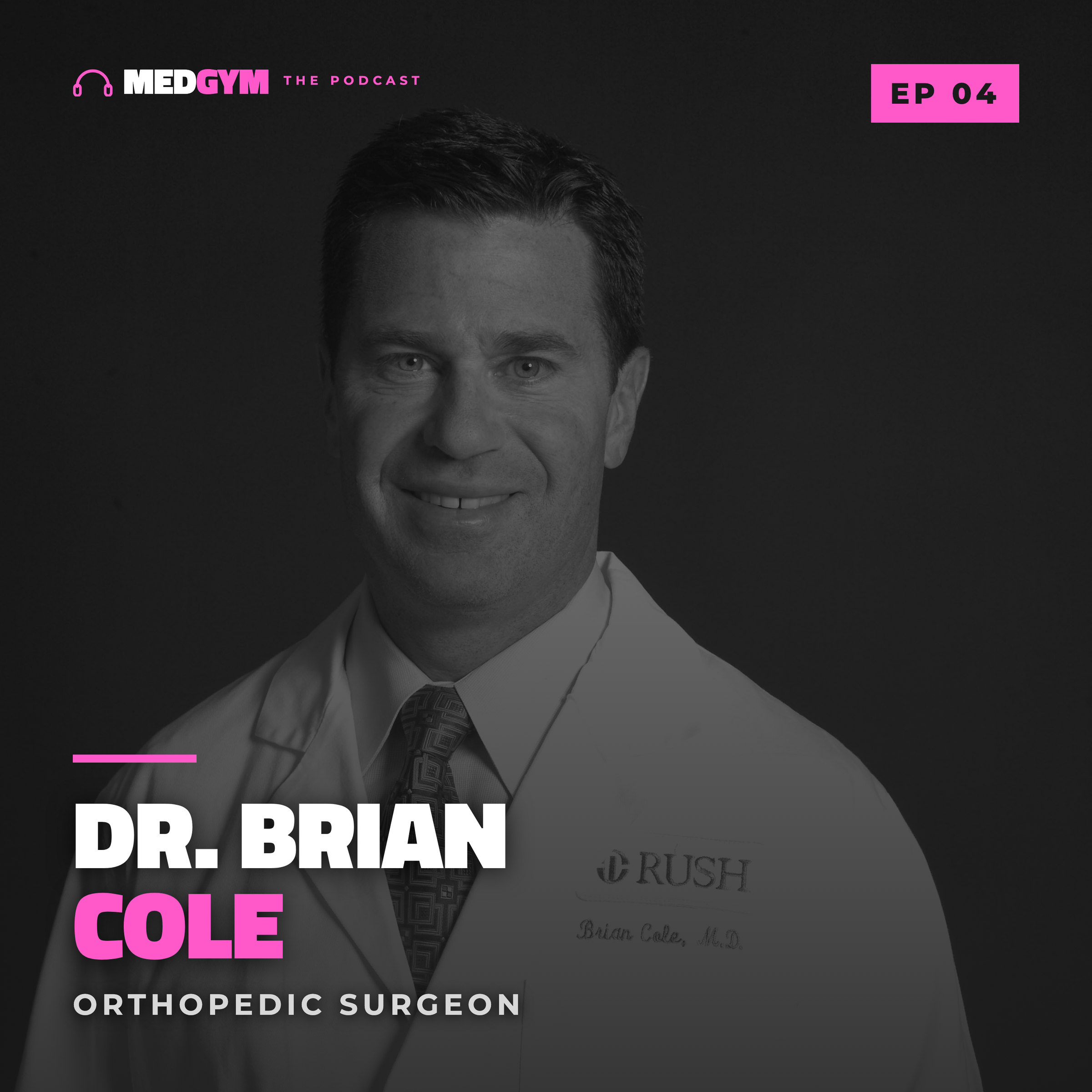
Gina Pongetti: Welcome to the MedGym Podcast. I'm Gina Pongetti Angeletti, physical therapist and someone who has spent a career in the gap between what an athlete's body can do and what it's being asked to do. The show is about health and sport across three pillars: mental, physical, and training. Most people know my guest today as the surgeon who takes care of professional athletes. He's team physician for the Chicago Bulls and the Chicago White Sox. He is also the team physician for the Joffrey Ballet as we mix art and sport. What a beautiful combination. Dr. Brian Cole is an orthopedic sports medicine surgeon at Midwest Orthopedics at Rush and a professor at Rush University Medical Center, where he leads the cartilage research and restoration center. He's published more than a thousand articles. He's a past president of the Arthroscopic Association of North America. And in 2025, he won one of the biggest research awards in orthopedics for his work on joint preservation. He also trademarked the phrase spare the scalpel, which for a surgeon is an interesting thing to build a practice around. Dr. Cole, thank you for being a friend, an amazing peer, referral source, and someone in the community to trust and work with, you and I for over 20 years. Welcome to the MedGym Podcast.
Dr. Brian Cole: Thank you, Gina. It's been a long run and I'm super excited to do this. So thank you again for asking me. Yeah.
Gina Pongetti: Thanks, appreciate it. we are we are spanning now on watching you obviously grow within MOR and within the community as a young, exciting, hungry surgeon that started doing fabulous things on athletes and then noticed that we needed a little bit more research and education. You rose within the ranks of MOR as being a leader and then took an orthopedic niche essentially within the cartilage restoration area. Tell us just for a minute about how your career has developed and how, you know, coming out of school, knowing all the surgeries and all of the information that you did, what made you take this specialization path?
Dr. Brian Cole: Well, Gina, so yeah, it's a good way to sort of set the foundation. I finished my residency, it's I'm twenty-nine years now, amazingly, in in practice. And I it seems like yesterday when I was in residency, I remember taking care of athletes when I was training at special surgery in New York, where the only thing we really had available for people who had cartilage problems was arthroscopy. So while it's a minimally invasive technique that uses a camera to, you know, look inside a joint and there are ways to manipulate the tissue. All we really had available at that time was to debreed or clean up fragments and so forth of of articular cartilage and sometimes meniscus tissue and joint lining and things of that nature. And inevitably, while it did afford athletes the ability to have symptom relief, it usually was not sustainable nor was it complete. So after my fellowship, which was at University of Pittsburgh, at that time we really had one technique that was well known, which is called a microfracture technique that was popularized by Dick Steadman. and when done correctly could get athletes back on the field or on the court or in the gym. but it was also highly unpredictable, not sustainable, and offered incomplete pain relief in many patients. So that was just around the time while we had with cell based technology where you can w that was just approved by the FDA, where we could biopsy a piece of cartilage, grow in the laboratory. We had a procedure known as an ostrapinal autograft, which where can take it's sort of like a hair transplant where you can take one plug of bone or cartilage from one part of the joint transfer it to another. And then we had human transplants of cartilage that were just really becoming mainstream amongst people interested in it. But when I came to Chicago the after training, there was really no formal understanding of the clinical decision making. There were no algorithms, we had very little evidence based medicine allowing us to have evidence based decision making. And you know, to me it was just a big hole in a space where I really knew I'd be taking care of high level individuals. They're not all professional athletes, they're just people who want to remain active and less pain who have these problems and and I think as importantly it's not just the knee, it generalizes to virtually any joint in the body, including the shoulder and the elbow, things that we also treat as sports medicine specialists.
Gina Pongetti: of course, with all of that excitement came in my mind from a PT perspective, we're not jumping straight to knee replacements. We're not having athletes quit because they've lost their meniscus or someone has, as we say, you know, trim and snip, right? They've taken everything away. But we can actually start to prevent the linear progression, if you will, of the arthritic process by keeping the ability for the athletes to have load protecting material in their joints.
Dr. Brian Cole: Yeah, I mean I think the issue is these are individuals who are really not they don't have the right disease for joint replacement. They certainly have activity profiles that wouldn't be supported by joint replacement. and in a setting where they have sort of intact joints as an organ, but early cartilage or localized cartilage where this is the space that they live in. And to your point, from a joint preservation perspective, we've more than learned that, you know, preserving tissue where possible is critical. But even that's a dicey decision making node because you know, going beyond going going over the midline and and trying to preserve things when they won't likely heal can take an athlete out of sport for extended periods of time only to subject them to a a repeat surgical procedure because we preserve tissue that wasn't meant to be preserved and they need yet another surgery after four to six months out of sport. So those are really tough decisions.
Gina Pongetti: Which I think is why our clinical decision making is is so important in listening to, you know, fixing the meniscus of a knee isn't going to help if you're not biomechanically balanced and if you don't do your sport properly in the first place. And like you said, if you're doing a preservation and then the athlete attempts to think that that is just the the miracle and it and it doesn't work, We kind of have to look at the whole picture. You're not looking at just the MRIs or just the CT scans, or people think that doing an orthogram like gonna miraculously tell us different things than just plain film. So for for people listening that might be parents or athletes, I mean, we have bones in our body and the bones would touch each other if they weren't padded by various amounts of things. You have cartilage on top of that bone that is almost like the padding on top of your concrete. And then in addition to that, in between, you have things like a meniscus in the knee, you have a TFCC in your wrist, et cetera. And When the padding goes away or is injured, there's less shock absorption, there's less ability to rotate and and move in all six planes of motion and take load bearing just with daily living, walking, stairs, et cetera, let alone up to 15 times body weight for a gymnast landing and and 18 times body weight in the in the elbow with tennis. So the goal is to make the structures that absorb stress live. and continue on working if at all possible. And if not possible, that decision has to be made.
Dr. Brian Cole: is if it's not possible that are viable to get an at keep an athlete back at their sport for a sustained period of time.
Gina Pongetti: I love it. And of course, hoping to walk and hike and lift your kids when you're 50 when sports go away. So it's not just about, you know, I mean, there's
Dr. Brian Cole: Well, it's not true. Yeah.
Gina Pongetti: there's multiple levels of goal setting. I think with elite athletes that you and I deal with, in that the answer might be different if the Olympics are in three weeks, because there's a lot of procedures that can't happen, as opposed to if your main peak event is in one year and we have time to rehab. And if sports are important to you, but maybe a nine out of ten and you really want to be a healthy 50-year-old. There's there's differences and decisions that one has to make that will impact your joints' longevity.
Dr. Brian Cole: Agree. Agree.
Gina Pongetti: So as we're as we're talking about youth athletes, and as you and I take care of a lot of pro athletes, but also the elite youth athlete, 15-year-olds, this this 14 to 15-year-old area where kids are not done growing, they're not skeletally mature, they're pushing themselves potentially overtrained, potentially not. when we talk about something like a 13, 14, 15-year-old with with joint damage, this is a controversial decision-making age. And even for ACLs, what you do. So can we touch on that just for a minute?
Dr. Brian Cole: Yeah, it's it's very complicated. And I know one of your areas inter of areas of interest and experiences is gymnastics, and that's a a specifically very interesting place. I'll tell you just to share an anecdote. this week I had a fourteen year old gymnast who tore her on a collateral ligament, which is really a baseball injury. People don't necessarily think about it as a gymnastics injury, but we see it Right, right. It's sort of that Tommy the Tommy John problem that you know we're
Gina Pongetti: Inside ligament in the elbow for those listening on the the inside here. Yep.
Dr. Brian Cole: so familiar with in our baseball pitchers of almost any age. But she's she had a repair, she had a postoperative complication of motion loss, ended up having yet another orthoscopy, is still continuing to have pain. You know, these are really troublesome issues because their physiologic exposure to their sport and load at this age is it's it's sort of like I used to use this analogy that it's it's like having a a Volkswagen body with a Ferrari chassis or a Ferr Ferrari engine and the the challenge is bodies have the ability to tolerate loads differentially as we mature. And especially with a sport like gymnastics, the the exposure rate is so insanely high. and the at a very young age, right, and oftentimes
Gina Pongetti: At a young at a young age when they might not be skeletally mature. Yep.
Dr. Brian Cole: it's a super specialized sport. They may not have the the relief from specialization during the course of the year from a recovery perspective. Parents are integrally involved. There's just it it's it's probably one of the most complex sports that I deal with quite frankly because of the age, because of the involvement in in with the parents, because of the commitment by the families to achieving excellence. And you're dealing with a the psychology of a young athlete who may not always be aligned. So or you know, and has to make really difficult decisions as an adult, yet they're they're still fourteen year old brains. So, you know, it's it
Gina Pongetti: And even from an from an anatomical perspective too, it someone could be 14,
Dr. Brian Cole: Hundred percent.
Gina Pongetti: but they could be skeletally 11 with the load of someone that should
Dr. Brian Cole: Yeah, these right.
Gina Pongetti: be 20, but yet they're not getting vitamin, you know, D and K combos with calcium to build bone properly. And are they dense? Is Wolf's Law working? Because Wolf's Law is great.
Dr. Brian Cole: Yeah.
Gina Pongetti: It's, you know, the more load, the more, the more you make for for everybody just to explain that. If you're sitting around doing nothing, your body is going to naturally not have as dense a bone because it feels like it's not needed. If you put more load on something, it builds. But there is also a a point of no return to that where you get to a point where too much load is actually breaking things down. So I think that's really hard
Dr. Brian Cole: Yep, all true.
Gina Pongetti: when you're demanding load bearing on joints and also stress and pressure without having the machinery, if you will, where the bones are fully dense, fully developed. and the muscles are strong enough to support the load that the joints. So we talk about overload all the time and overtraining. And for you and I,
Dr. Brian Cole: Yeah.
Gina Pongetti: it might be very different. You know, if Jenny is a gymnast is doing 10 routines and Josie's doing 20, maybe 20 is good because she's used to it and her body's used to it. If the 10 goes up to 20, it might not be good for that body because they're not used to it yet. Age training, nutrition, you know, everything. So some of the decisions that you make, I've I mean, if we pivot just for a second, the UCL is interesting, obviously, because With gymnastics and with weight bearing, there's there's forces and there's tension, and we have to look at how you know the the hand is only as good as the elbow is because the shoulder provides the strength and you have to have the elbow in between to make it so that the force can transfer. So when we talk about the knee, what are some of the controversial things that if a 13 pre-adolescent, pre-pubescent, if you will, tears an ACL or does something? that has to be
Dr. Brian Cole: Yeah.
Gina Pongetti: considered everything from ligament to the angle that you place it on to allow for growth. Do you wait? Do you delay the surgery? What do the anchors look like different? touch on that just a minute from a a female adolescent.
Dr. Brian Cole: Yeah, I mean I I can yeah sure. Sure. At a high level, ACL injuries continues to be somewhat of an epidemic amongst our youth because they are starting earlier, they're more athletic, they are more they have more exposure to their sport. And most if most ACL injuries happen in a way that are non contact and due to some perturbation or something that happens in their environment where they're brain can't instantaneously connect to their knee. And normally if you're not fatigued and you're doing things properly from a biomechanical perspective, which is why ACL prevention programs actually do have an impact, especially in young women, then ACL tears happen because the forces exceed the ability of the ligament in the center of the knee to do what it's supposed to do. The the biggest tragedy with ACL injury is not really our ability to fix it and get them back to play. I can tell you that's a very high percentage So you feel good, I feel good when, you know, not all things we do, and I know we'll talk about this are surgical, but this is one of those that if you participate in a sport that involves acceleration, deceleration, rotation, and so forth, you typically one typically tears your ACL doing those activities, therefore they obviously needed it. As they get back to that same activity, they're going to need it again. So skillful neglect that doesn't often work in this case where you really have to tet have it reconstructed. But as I was alluding to, the tragedy is the downstream consequences. So having been in practice long enough, I'm now seeing the ravages of the adolescent ACL tears as adults, young adults, and you know, middle aged people who now have osteoarthritis. They've had osteoarthritis maybe for 10 years before they actually had symptoms. But the true epidemic is the problem of downstream consequences of tearing your ACL, associated minuscle tears, or articular cartilage tears, the two kinds of cartilage in the knee that happen at time zero. What are the consequences of that? And that's actually the Probably the biggest issue right now that we're seeing is, you know, they do okay, get back to sport, perform well. rare incidents of retail, it does happen, but it's rare. We've gotten good at that. You've gotten great at your sports performance and helping us objectively determine how to get them back to sport. that's all good. We could get better, but the real problem is what happens tomorrow. And I think if I was to spend my efforts on anything, it would be anything in addition to what we've done so far, I would say it'd be on ACL prevention strategies because if you want to have an impact on the the the the human health societal conditions in muscoskeletal medicine and sports, this would be one for ACL injury for sure. I mean that's clearly reference there. All true yeah, all true. Yeah, all true. That's yeah. Yeah.
Gina Pongetti: Yeah, well, ACL's ACL's Achilles and hip labrums, right? Those are our three, though those are our three big I know you're not a hip expert, but just to toss that in, everyone in the world wants to fix a labrum that's torn in the hip.
Dr. Brian Cole: Yeah.
Gina Pongetti: But at some point in time, if your glutes mechanics aren't good, if your hamstring quad isn't good, proprioception, response time, testing with things like blaze pods for
Dr. Brian Cole: Yeah.
Gina Pongetti: how quick you can make deceleration rates, everything, you're it's it's just gonna tear again. I mean, it's a it's a gasket that's there for a reason and the support structures have to also be there. And to your point,
Dr. Brian Cole: Yeah.
Gina Pongetti: the surgery itself is fantastic. The rehab protocols we've got kind of buttoned down, but are people looking at the whole picture of the athlete that you said something that was great. When forces exceed ability. So this is just like I say, overtraining is overtraining if it's overtraining for your body, right? It's all on a continuum. When forces exceed that specific athlete's ability, I want to change directions in 0.2 seconds, but my body, my mind, my reaction time, my ability to fire my glutes, et cetera, takes 0.4 seconds, we have a problem. Right. So,
Dr. Brian Cole: Yeah, yeah, that's yeah, to elaborate just quit briefly on that, you know, the if you look at when ACL tears happen, they're you know, you you and your profession do an amazing job of measuring time zero capacity, right? Like we have all these metrics that we can look at early in the phase of athletics and sport. The challenge that we see is that these injuries are not happening in the first five minutes, they're happening with fatigue. So if you look at the NBA For example, when ACL tears happen, it's not so common in the first quarter. It's usually in the third quarter or the fourth quarter when fatigue has set in. So we we have so much more to learn and so much more to think about from a monitoring perspective, which is some of the research that we're doing now is using AI driven garments, for example, to monitor the the you know, flexion angles, rotation angles and and hyperextension moments, and net valgus, you know, when people sort of drop and land and they the the foot goes to the outside. All of those are really objective things that you and I know about. They're all associated more than 85% of the time with an ACL tear. We had one study where we looked at NFL athletes when they tore their ACL. So we had videos just looking at their knees to see could we stratify or categorize when they were gonna t what what they look like. We say there's like type one, type two, type three ways to tear your ACL. Virtually everyone looked the exact same. They plant, they're no there's no one around them. They plant, they may be by by a side marker or a a line judge or something or other. There's some perturbation. They externally rotate, net valgus, hyperextension, and it just happens the same way every s like you would look at these videos, you swear it's the same athlete, but for the s size or skin color or other, you you only know it from that or the or the color of their uniform. But the mechanism, yeah,
Gina Pongetti: That they're different, right? Right.
Dr. Brian Cole: the raw mechanism when you look at it, it looks exactly the same every single time. It's it's it's fascinating. So those are the things we can make an impact.
Gina Pongetti: Right. I think the the but so going back to that from a time zero, I will even preface that, and this is kind of a push for what we do as PTs at both Achieve, you know, our local clinic, but also in the nation. And the challenge that I make, baseline testing is available. And baseline testing is at time zero minus whatever the heck you want it to be. So every year we can use valid force play testing, et cetera, blaze pod, speed, time, wearables, and say Brian is an athlete. And at Brian's absolute best, what is his response time? At his absolute not fatigued state on a Monday versus a Friday, at the start of practice versus the end, at the start of a season or a microcycle versus the end, where are you? So when you get injured and you come back, I can't test your leg when you're injured. I can't double leg jump test you when you tear one of your ACLs, but I can look at four months ago when I had data in March for it to know, not predicting injury, but baseline testing everyone where you were at your best. I don't care if somebody else jumps 28
Dr. Brian Cole: Yeah.
Gina Pongetti: inches. If you're if your pre injury jump was 32 as a gymnast, you're doing double layouts on floor, you're a figure skater, you're landing on your right leg after you know, a quadaxle. If you used to jump 32 inches and now you're jumping 26, we have a problem, right? So the data is good to to amortize and to anonymize, but this baseline
Dr. Brian Cole: Yeah, agree. Yeah, I think it's very important. Yeah.
Gina Pongetti: is is is so important. And we
Dr. Brian Cole: Yeah.
Gina Pongetti: also see that with the wearables, most recently one of these amazing NBA articles kind of resurfaced, which I'm sure you have have looked at and seen, but the 10 to 12 percent increase in playing time, is now retrospectively we've looked at it being predictable for Achilles tears. And
Dr. Brian Cole: Yeah.
Gina Pongetti: so it it wasn't that they all of a sudden played pickup basketball with their kids or that they went skiing or that they did something. If they look back and somebody literally watched, and this is how we do medical research, sometimes it's fancy Dr. Cole, as you know, and I know we're in the office with data and sometimes it's just someone sitting watching film and saying, how much did this athlete play every single game? when they touched the floor and how much were they out. It we're not even talking practice increase. And
Dr. Brian Cole: Sure.
Gina Pongetti: there's some big predictability now on just the changes. And that's why wearables, we could do a whole session on wearables, but wearables are important. I mean, yeah,
Dr. Brian Cole: Sure, I'd love to do that sometime. Yeah.
Gina Pongetti: yeah. We look at, you know, aura ring data and Apple Watch and Garmin and everything to look at your sleep and heart rate variability and and everything. But just simply knowing if you have a vest on in the World Cup, for instance, How quickly when you change directions, does the fastest player change directions as opposed to the slowest, as opposed to the person that got injured? our baseline testing is force plate, force frame. So we're doing double leg jumping, single leg jumping. We're not just watching the quality of your jumping, but to the microsecond, we are watching how much your tibia slows down. Is your tibial inclination faster because you don't know how to actually decelerate? Can you jump really well, but your landing is awful? When you are doing side to side work on something like a blaze pod, which is just a a sensor that allows you to move in whatever directions that you would like to move. And then we can time your ability. Is somebody, is their response time good or bad? Are they, you know, are they ready enough to come back? Or are they still slow compared to elite athlete, not compared to regular person? So,
Dr. Brian Cole: Yeah. Yeah, all all all great points.
Gina Pongetti: All good stuff. Well, let's pivot just a little bit with my life and your life being such a mix of both art and sport. And as much as we do these pro athletes from a, you know, traditional perspective, we also take care of ballet and gymnasts and figure skaters and those professional athletes. So when you look at the difference between, you know, being the doc and working with the bulls versus Joffrey, what do you see as the similarities from the from combining art and sport? And what do you see as some of the differences?
Dr. Brian Cole: Well, you know, I mean the first thing I give a shout out to Simon Lee 'cause Simon is you know, is sort of the lead for Joffrey Ballet, but what happens is Simon has a foot and ankle specialist, there's that's not my specialty, but most of these many of these injuries are low extremity. So the dancing population is fascinating because you're dealing with a the biology of a dancer which is r truly related to, you know, physiologic things like bone density and overuse and vitamin D and all these and nutrition and so forth, as you and I know. but then you're dealing with traditional overuse type injuries that can be plaguing and vexing. And that's I will tell you that the my dancers and my my skaters can be some of the hardest ones to provide sustainable solutions to to get them back. And it's it's a little like a racehorse when they're functioning fine. They're amazing. When they get injured, it can be a vexing problem to get them back because these are off when they're simple and they're ankle sprains and tendonitis and things like that. That's not what I'm talking about. I'm talking about structural damage that no I always speak about the marginal benefit of the things that we do. And i we're really good at getting people back to recreational, high-level recreational, sustained activity levels. But when you're trying to squeeze out very high fit to to be able to adapt and respond to very high physiologic loads and then keep keep people symptom free or symptom less, we're not so good in many conditions. So we deal with a lot of long standing or chronic issues that can be very challenging to get these types of athletes back, much more so than some of my collision athletes who play soccer or football or even basketball, where there's a singular structural problem. We fix it if it needs to be fixed, or we do an injection or some ortho biologic to get rid of their symptoms. these things often go chronic and can
Gina Pongetti: Right. yep. Right.
Dr. Brian Cole: be really challenging to sort of parse together a comprehensive program, not just surgical that gets them what they need. So they're they're the most demanding athletes. It's it's it's also there's some gender specific challenges that that you have to we have to be sex specific, I guess that we have to be mindful of. when we're treating these athletes because there are just gross differences between the what nutrition brings to the table, what bone density brings to the table, nutritional, you know, food in c intake and so forth. All of that stuff matters. So, you know, while I orthopedic yeah, just add yeah, all of that all of that relates. Right. Right.
Gina Pongetti: Well, and pubescent development, right? With hormone development and is the bone gonna heal as fast because at fourteen versus twenty two? And are your injuries happening
Dr. Brian Cole: Right.
Gina Pongetti: at certain times in your cycle? Are you managed from progesterone to estrogen to testosterone
Dr. Brian Cole: Yeah.
Gina Pongetti: development, et cetera? And I know that that that matters and there's been a lot of ACL research on it. I think there's a lot of people trying to find answers that might not be exactly out there. with trying to say that, you know, your third week, second day is when most ACL tears happen or Yeah.
Dr. Brian Cole: Yeah, but what are you gonna do? Yeah, yeah. I mean those are interesting those are interesting ideas. the reality is when we do our research and you're probably the same, we're trying to find things that, yeah, if we find this out, what can we change? You're certainly not gonna hold an athlete out of sport when they're in their third week. You know, so
Gina Pongetti: Right. Right.
Dr. Brian Cole: so but the issue is it's relevant because you can piece these things together and it speaks to how, you know, I can just tell you orthopedic surgery is like this big compared to the understanding you need to have the surgery is the easy part. It's the really easy part. it's the things that lead up to injury, the potential windows and opportunities for injury prevention, and then how going through the recovery process and then keeping them back in the sport. And not to mention, not the least of which are the psychological is issues of trying to get an athlete back to sport who's maybe never been injured before, who doesn't have the faculties to to get back and the anxiety associated with trying to get back with fears of re injury or performance and so forth. So it's it it it's what keeps me coming to work every
Gina Pongetti: Right. Well, with our with our team,
Dr. Brian Cole: day. Yeah.
Gina Pongetti: with our team that we create with our elite athletes and Olympians, when I manage an athlete, we are sport psych, we are nutrition, we have phlebotomy, so study of of blood work, nephrology if we need to. We do bone density, we are doing DEXAs, valve scans, pre we are doing orthopedic screenings for the athletes, flexibility, reaction time. neuro performance. So it's all included. And I think when a parent asks, why can, you know, how does how do these athletes get back faster when you're at the OPC, why does it work so well? Or what can I do? What can I buy? Can I make it better? And I said, well a lot of it is exposure to everything, but it's just keeping your engine healthy from the inside out. And I think fixing it by surgery or doing one more day of PT is often people's answer to things. And often the answer lies in what is your state of mind? How apprehensive are you? How confident are you in motion? Are you sleeping? Are you recovering? and that's the piece that I think is it's not out of your and my hands and our staff and the amazing job that we do to educate people, but I can't make you sleep more. I can't make you chicken at home every day. I can't balance out
Dr. Brian Cole: You sure? Are you sure you can't do that for me?
Gina Pongetti: What I can't I mean, if we wanted to offer it as a side as a side gig, we could but recently we did MedGym has a gymnastics course that offers continuing hours to its medical contingents. So anything from a ATs to physical therapists to physicians, etc. And we had an NCAA specific and I had thirty-six NCAA gymnastics athletic trainers in a room. It was fantastic. And one of the things Doc, that they talked about a lot was that they are really trying to use technology to predict the ebbs and flows. So just like you said, can't just tell somebody that they're third week of their cycle, they can't do things. But if we start to see a trend that we know that you lose 5% of your jump height or your quad function, whether it's because of hormone, cycle, fatigue, et cetera, we know that we can actually alter your practice schedule. And that's what should be done from an anticipation perspective. We are encouraging the schools and the trainers and myself and committee are working together on trying to get testing done on Mondays of each week, but also Fridays at the beginning of a floor workout, but also
Dr. Brian Cole: Yeah. Yeah.
Gina Pongetti: the end to see what that delta is or that fatigue factor is and what you can handle versus what I can handle versus what Jenny can handle are all different things and maybe. There's athletes that just tank from a Monday to a Friday. We have to be mindful of that. If they have meets on Friday, Saturday, give them Thursdays to rest, et cetera. Maybe someone is, man, you do four floor routines And by that fifth and sixth one, you are so depleted. Why are we doing skills that would risk it? Same with soccer. If if we test how quick you are and what your reaction time is, Monday versus Friday, start of a three hour practice versus the end, we can really help with some of that you know. What your engine is available and capable of doing.
Dr. Brian Cole: Yeah, right. Yeah, I agree.
Gina Pongetti: let's pivot for a second to one of my favorite things that you have coined the spare, the scalpel. I have worked with some amazing orthopedic surgeons and doctors in my days. And of course, as I think everyone's bias is that if you are a PT, you're anti-surgery. If you're a surgeon, you think you can fix everything by cutting. If you're, you know, and I love the fact that and Dr. Mark Hutchinson was on as well. in talking about surgery is a tool and it's one of the tools in your toolbox. Talk to us about how you came up with that and why the spare the scalpel is so important for you personally to abide by, but also to teach all of the wonderful fellows and residents that are underneath you as well.
Dr. Brian Cole: Yeah, it's a it's a long topic and you know, I don't think I'll be able to do it totally justice. I would say if people are interested in hearing my thinking about this, I have a TEDx talk that's on my website. I have a presidential address I gave where I talk a lot about this, but at a high level, you know, I think frankly there's too much surgery being done. I think that we we catch patients at their worst when things sort of gravitate to the mean typically. You know, if a patient can get into a doctor's office in the first week of their symptoms, they're more likely to have surgery than if they were made to have a delay in actually to get seen and then half the time they actually cancel the appointment. So th th there's there's a great expression by a tool goande. Says we're all sort of rotting from the inside out. And there's this, there's this dependence upon imaging and MRIs to replace the thinking that goes into being a clinician, where the history, the physical, the understanding of how things change over time naturally, how they may never contribute to symptomatology, knowing what's okay to ignore, or what I call skillful skillfully neglect, that won't cause a problem later on. if neglected at this time. You know, the challenge from a patient and a physician's perspective, a physician's perspective, I think there's not enough listening going on. in other words, they're not asking what the patient why you hear, what would you like to see happen? So you can take the same MRI finding, the same arthric finding, the same complaints and come up derive a different solution based upon what the individual is actually desires to achieving. I have patients who come in and say, look, I would like a meniscus transplant. And I start out by saying, Look, what would you really like to achieve? And they would say, Well, I'm functioning fine now, I have no pain, I'm doing everything. I just don't want to have a knee replacement when I'm f when I'm fifty. That's a very different discussion than someone who comes in and says, I had ameniscus removed, I did great for six months, I'm now getting pain and swelling. I can't even walk for any prolonged period of time, let alone do my sport. What can you do to help me? I you know, when you yeah. It's objective,
Gina Pongetti: Objective functional assessment changes, right.
Dr. Brian Cole: functional, but it's also, you know, I think I do I I you know, as nearly thirty years in practice, I my my office, if you spend a day with me in my office, no more than twenty percent of what comes in will ever get an operation. And everyone gets a discussion about what's okay to neglect, what's okay to accept. People don't re people often believe and understand that if they're in pain, neglecting this it will lead to a worse problem later on that A either can't be helped if you don't treat it today or will require an entirely different solution later on than if they invoke a solution today, even when the symptoms are mild. So one of the first things I start out a visa with besides asking, what would you like to see happen? What are your concerns is if I told you that this condition will not be made worse by remaining active, would that help f would that help you? Would that provide useful information for you? Because that is true in various things. And you immediately you see the color come back in their face and the parents take a deep breath. And they're like, yeah, I just assume that if I stay active, because I'm doing fine, I have a little bit of this discomfort in the back of my shoulder with normal imaging or even abnormal imaging. I can give you, you know, dozens of examples where pathology is being treated that never needed treatment and only needed a discussion. I mean, that's that is the the nature of my office twice a week with a hundred and fifty patients or more. With very few of them ever requiring surgery for them to achieve a reasonable goal that is sustainable. So that's the high level. Patients are concerned about.
Gina Pongetti: I think we see it we see it from a PT perspective, Dr. Cole, when someone says, My shoulder hurts. I went to my GP. I somebody ordered me an MRI. It's two pages long and there's so much going on. So I have to fix it. And I said, Well, but you can only lift a five-pound weight with your with your shoulder. You have no periscapular strength, your cores, I mean, there's all these things. So I'm happy that you're all of a sudden really nervous and frightened and called to action in your mind by this MRI. But what about the call to action by a physical examination for you when I tell you all the things you're not doing to take care of yourself, that if you fix those, this can still exist. You could have a small labral tear, your bicep could be a little thickened, you could have things, but fixing that isn't going to fix the issue. And I don't think people take the time to explain it a lot of times because the patients also don't want to hear that. They want the easy answer, which is hard.
Dr. Brian Cole: Yeah, it's it's yeah. Right. Well, I I don't you know, yes, yeah, yeah, yeah. I think that the other thing just to layer on top of that is that people don't understand the significance of those problems and they don't understand
Gina Pongetti: Of course.
Dr. Brian Cole: that they're just part of our anatomy. And the more sensitive the test is to look at our anatomy, the more likely you are to to to find something. So the MRI is the biggest distractor. You know, I I get emails to people, look, I'm having knee pain or elbow or shoulder pain and I need an MRI. I'm like and I'm just like, look, nobody has ever felt better or been cured by an MRI. Please come in, let's talk, let me do an examination, let me figure out what's going on, and we can maybe spare you from ever getting an MRI. The challenge in the office now is that people have these the imaging done. They go directly to Claude or Chat. They come in with a list of the research that they've
Gina Pongetti: Yes.
Dr. Brian Cole: been doing. And the entire dynamic of my office is spent Diffusing what isn't relevant. I I'll just, you know, give you one quick anecdote. You know, rotary cuff disease is really a degenerative disease. Most of us will go to our grave if we live long enough with a rotary cuff tear. There's probably more than seven million people over the age of sixty five and a disc issue. Yeah. Right, right, right, right.
Gina Pongetti: And and a disc issue in your back, right? And a labral tear in your hip. I mean, these are all degenerate these are all continuum issues that everyone's on a
Dr. Brian Cole: Right.
Gina Pongetti: path to degenerate. It just depends on how much you do with your body, how well you take care of it, as to where that trajectory is going.
Dr. Brian Cole: Yeah, so I'll just finish this and just say that look, there's probably five hundred thousand rotary cuff repairs done a year with just take the age of sixty five. More than seven million people have tears and don't know it. So if if you're not busy enough and you want to get busier as an orthopedic surgeon, you can order a bunch of MRIs and treat the MRI. The reality is that people adapt to these degenerative conditions very, very well and and never have issues with it. And when they do have issues, the vast majority of them will respond favorably at first to an education to help them understand that. This is the normal process of aging, that you're symptomatic because you're out of balance, and I'm gonna send you to Gina and she's gonna do scapular strengthening and so forth to get rid of the deltoid pain. Maybe we'll do an injection, and you have a 75% likelihood of remaining surgery free at five years, as long as you believe what I'm saying. You know, the biggest factor in that clinical example is not that the size of the tear, the the the the intensity of their pain. what activity may or may not have been associated with the onset of that pain, but it's actually the belief that a that physical therapy will will work. That that's really what it is. So the challenge is patients are often, for lack of a better term, poisoned by information that they're either getting in the internet, they don't really know how to process it, they have no level five experience, which is just your clinical experience, and you can't get the internet or Claude or d which I use all the time, can't give you the clinical judgment the in between stuff to help them understand it. It's just not out there in the public domain to process a response that helps a patient really know what to do with that information in some instances. So it's a it's a it's a time sink, but it's it's the biggest thing I do is education. That's that's that's
Gina Pongetti: Right. So I mean education is such a yep. Yep.
Dr. Brian Cole: my entire day is talking to people like I'm talking to you about, you know, what's what's relevant and what's not
Gina Pongetti: I think we talk to our staff. And when I'm setting our elite and Olympic athletes up throughout the world in the country with new medical teams, that the biggest thing that you can do is be a salesperson. And people look at me and say, What does that mean? Nobody wants to sell things. I go, No, no one's selling products. I'm selling the idea that you putting time into your health is going to matter. I need to sell to you that working on posture and nutrition and re rehab, relaxation, recovery, et cetera, is actually going to help things. I'm not feeding lies. I'm we are not making things up. We are trying to convince you that taking care of yourself will help so much of of the problem. And we're trying to actually make it so that you value that. Instead of valuing a surgery and a rehab and an outcome, how about valuing making sure that your body is in its best state possible to avoid that? And that's what we do so much of. And I think with all of you know, VC firms and everybody coming into healthcare, trying to say now we're gonna see a hundred patients a day and we wanna say fifty patients a day. You're seeing fifty, let's do fifty-five. And some of that is I can't go faster because I need five more minutes just to talk to the patient. I need that patient education. I need to build that trust by actually explaining to you why this matters. and I think that's getting lost as well. and the art of medicine is is getting lost, which is sad, but
Dr. Brian Cole: Yeah, yeah, yeah. Yeah, I think it's true. It's sad, but the the challenge is that the economics are not supporting quality healthcare these days. So the macros are pushing people, you know. So it's a shame.
Gina Pongetti: Yeah. Of course. Well, and we're absolutely our our staff is feeling it too, just as PTs, where we're booking X amount of patients and then we have to talk to the agent and the coach and the college and the strength coach and message. And that's the part that I love the most is educating and making sure the team goes together. But where does that fall on responsibility? Is that insurance responsibility? Is that patient responsibility? Is that just in our free time? And that's what really, you know, makes it run. so now that we're talking about AI and people doing online research, let's pivot for a second to orthobiologics, including PRP, stem cells, et cetera. we get hundreds of questions every day of people thinking that they have a tear and PRP is like super glue and it's gonna make them better, and stem cell is just gonna build them a new meniscus, etc. The the misinformation out there on what it can do to help and when it is appropriate, and the fact that the clinician has to actually make decisions as to if this is the most appropriate tool in the box that you have, talk to us a little bit about where how you use it in practice and in best practice in
Dr. Brian Cole: Yeah.
Gina Pongetti: medicine, you know, where where we are as a society with ortho biologics.
Dr. Brian Cole: Yeah, so you know, for some sort of patient friendly information, what I'll just set to set the stage, I'll say that number one, we don't have a single true stem cell product available in the United States. So everything we do is predicated on the growth factors that are associated with some of the things that we use to incur symptom modification. Now there are So so the the people have this impression or perception that if you inject something, whether it's PRP or stem cell or quote stem cell work from blood or fat, that it will regenerate something, the answer is it won't happen. It won't happen, it doesn't happen. Everything we do is symptom modifying. Everything we do in the United States is not necessarily attributed to the stem cell itself. So the first thing is cleaning up the message in the narrative. That doesn't mean that doesn't have value. We use these orthobiologics on a frequent basis, but it's a symptom modifier that when used in the office setting can reduce inflammation much like a steroid injection can, and potentially potentially promote a healing response. But it's not as though that an injection of anything we know, even in the world, Will regenerate a new meniscus or just through an injection will regenerate articular cartilage or a new rotator cuff. Now, again, that's not synonymous with that, it doesn't have value. So what we do know, for example, as an office-based treatment, the use of platelet-rich plasma, likely due to a composite of the absolute number of platelets that are in the injectable, combined with some rubric of The number of white cells and so forth can reduce the symptoms of pain and swelling in patients who have osteoarthritis. We do know that if you use some of these potentially for tendinitis, patella tendinitis or jumper's knee, or lateral epicondylitis, tennis elbow, or medial epicondylitis, otherwise known as golfer's elbow, or even rotator cuff pain, we might be able to reduce symptoms. We also know that when used as a surgical adjunct, and this is all stuff that we've studied in patients, as an adjunct, for example, to rotator cuff repair, we might actually reduce the retir rate. So you might argue that that's quote regenerative as a surgical adjunct. We also know that using it at a time of doing a cartilage transplant, it can improve bone healing from a donor graft. And finally, we also know that there might be some benefit of using these at the time of surgery for an ACL reconstruction. But true stem cell work with cultured stem cells is not available in the United States. Now then you'll say, naturally, well, why don't we go outside the US? What's available?
Gina Pongetti: Yeah.
Dr. Brian Cole: Even outside the US, there has yet to be a cultured product that can be used in a non-surgical situation to reliably regenerate or recreate tissue. So unfortunately, even in the Chicago land area, we have a lot of stem cell tourism here, unfounded claims, misrepresentation. misprep misperception by a patient and financial outlays for hope that are not reality in terms of the mechanism of action that is not synonymous with they may not help. So I think that's important. But they vis a vis-a-vis
Gina Pongetti: I think the reduction of symptoms
Dr. Brian Cole: a different mechanism than pe people have been led to believe. When then the final thing I'll say is we do have one stem cell technology that's truly stem cell. It's using stem cells from maternal core blood. That are cultured to millions of cells that are combined with another agent, hyaluronic acid or a lubricant, that are used at the time of surgery to treat areas of cartilage loss with in people who have early osteoarthritis can regenerate cartilage and bone. Okay. So we have that's a true stem cell product that is combined with a surgical procedure. as an alternative to other things that we have or things we don't have in patients with osteoarthritis. So that's a clinical trial where
Gina Pongetti: But those but that's from cells that's from cells from childbirth where those the goal and the job of those cells is reproduction, growth, new everything. It's very different.
Dr. Brian Cole: And the mechanism of action for what they do, well, but and and connected is the mechanism of action, which is related to the cells themselves. All of the other things that we use it for are not necessarily related to the cells themselves, and any claim that they are would be is a distinct violation of what the FDA allows us to do or say. However, the growth factors, the the milieu or the local biologic environment can be modified with these things. And Not the cells themselves, but potentially growth factors that are produced in PRP are not stem cells. And bone marrow has a l a couple of cells that you could say are stem cell receptor positive if you identify them. But I just think people need to understand that they're often spending money on something that has a perception of regeneration. You can certainly argue if you wish to spend money on something that will modify symptoms, that's a reasonable conversation to have. But please understand the mechanism of action. isn't what most people think it to be. And that's the part that we've become very involved with is the ethical, responsible use of these ortho biologics through the Biologics Association. I'm the chair of that organization. I just came off as being chair but still on the board of directors. You know, our mission is to help educate surgeons and non surgeons who utilize these to create a healthy, ethical environment that doesn't take advantage of wishful thinking or desperate people to get better for things that actually won't do it the way they say it will or won't do it at all, independent of the mechanism.
Gina Pongetti: Well, there's also the time factor too. If someone is going to have any of these injections done, you can't just go back to creating inflammation and stress 24 hours later and expect for what was miraculously injected in you to just all of a sudden
Dr. Brian Cole: Right.
Gina Pongetti: be better. So I take a picture, for example, and you do a UCL, they used to have pain throwing at 90%, now they're throwing at 95, because in their minds. It gave them this miraculous boost and now they're actually putting themselves at more risk because of that misinformation and false confidence in what it's helping. So we see re-injuries often from a PT perspective. And none of these studies have done. This is just anecdotal from myself and a bunch of my Olympic peers and and people that are treating that truly see it's giving a false sense of hope and then you're doing a little bit more because you are like, I'm good. I think I can do more. It's like a booster. On a video game, right? And then they're they're pushing. And that's when kind of a second layer injury is happening. The symptom reduction in inflammation is actually biological, very different than a mechanism of a cortisone injection to try to take it away with red blood cells and the combination of whites and and that proper ratio. You can actually change the local habitat of in for inflammation, if you will. But again, it's symptom and it's It's not glue. Right.
Dr. Brian Cole: And that's okay. I mean that's but and that's okay though. I mean I think patients come to us because they have symptoms and loss associated loss of of of function. That's the business we're in is treating symptoms. If I had a pill that made people feel better, that was safe, I don't need to to replace stuff. I just need people to feel better during while there's on while they're on this w earth and do it in a reliable, sustainable way. So I think the paradigm of everything needs to be fixed, which is the concept of spare the scalpel, is what we really need to focus on.
Gina Pongetti: I also think that making people feel better that triggered an interesting thought. Sometimes people will get your cortisone shot and then all of a sudden your planar fascia feels better for a minute, and now you go run 18 miles when six hurt yesterday actually causes and can cause more damage to the system if you're masking symptoms. And again, we this is a whole three-hour discussion, I'm sure we can have. But if you take enough,
Dr. Brian Cole: Yeah. Yeah, that's a whole different discussion.
Gina Pongetti: if if you are actually masking symptoms and you need to go to your your daughter's wedding. And you want your back to feel better for a minute while you're dancing or
Dr. Brian Cole: Yeah.
Gina Pongetti: your feet to feel better, that's a different story. If we're masking symptoms of something that when pain is supposed to be your body's way of communicating with you, one aspect of it, right? Of course, the symptom damage happens, the iceberg theory before we actually feel the pain. But now we're masking what our body is telling us, and now we're pushing more because we don't feel that natural feedback. symptom management is an art.
Dr. Brian Cole: Yeah, it's a it's a very yeah, yeah, it's a it's a like you say, it's an art, it's a very deep discussion. I would just say that many symptoms are caused by inflammation and not tissue pathology. And if you can eliminate the inflammatory response vis vis a cortisone injection or other in certain clinical situations, it's not a band aid necessarily, it's therapeutic. So I could give you multiple examples where I would prefer to provide a solution to a patient to eliminate their pain with no concern that they're going to be masking so much that they're going to cause further injury. There's no question what you the scenario as you said, there are there are examples of what you just said. But there's also a number of examples where it's not just temporizing or quote a band-aid or a mask, it actually eliminates the pathology that's causing the symptoms, which have nothing to do with the underlying quality of the tissue. So It's a balance, but you have to understand what you said is, you know, if the mechanics are not proper and so forth and you're taking advantage of a pain free environment or painless environment, there are secondary downstream consequences that that have to be thought about. Yeah.
Gina Pongetti: fantastic. It's a great, it's it's why it's the art of medicine and why it's not just asking Claude how to fix something, enter in this drug, and in five days you'll be better, which is hard to explain to people. transitioning with that into why what we do is such an art. There is such a difference right now in medicine between general treatments, general practitioners, getting certified from a PTMD perspective in orthopedics or understanding bones and joints of the body. Elevating that to sports medicine, which is like a third tier, and then even going to a fourth tier, which is understanding pro athletes. I get asked all the time, from a shadowing or from just a career perspective, and I'm sure you do as well, how do you do what you do? And I couldn't answer that in in a hundred hours. but a the the big jump between sports med and elite athletes, or even ortho and sports med is understanding all of the factors that go into things, working with agents, working with timelines. Knowing what a free agent contract looks like, knowing when someone's re-signing what that looks like, what does the combine do when you're making the Olympics? What is the process for each sport and each athlete so that when you are identifying potential solutions for the athlete, you can have in your mind, I know worlds are coming up, or I do understand that you need to be at camp starting in March. Let's work backwards from things. Tell me from your perspective what the biggest differences are from jet a general orthopedic surgeon, physician, and taking that to the pro and elite level and the variables and the knowledge gap that is that is there and and what makes
Dr. Brian Cole: Yeah.
Gina Pongetti: you know, what makes that so unique.
Dr. Brian Cole: Yeah, I mean on the one hand, elite athletes are no different than patients who desire to have a recreational life without pain and normal function. There are a lot of variables there that you just alluded to. And the communication piece is is critical. So the number of of people that have to be communicated with who actually directly participate and are stakeholders is exponentially higher. It creates more noise. So you have to make sure that the communication is very clear so that reduces the chance of a misstep from person A to person B to person D. So that's really critical that it happens somewhat simultaneously with care being delivered so that everyone is on the same page for lack of a just a very simple simplified way to think about it. dispelling misperceptions amongst all the stakeholders who can sort of make the make the treatment very challenging and the expectations very challenging. The decisions we make in the population you're describing are often very different and we're willing to accept short term relief versus long term sustainable solutions because an athlete really their athleticism is their asset, it's their financial viability, it's their psychological platform that they live by. And if it's taken away from them, they are it's it it it's it has obviously the mental health impact, but it has simply the financial impact where they're trying to have a job and make money. It has an impact on the people around them because they're often responsible for a large number of people. So it's a system approach, but what it leads to is the the willingness to adopt solutions from a subset of solutions that provide limited time frame of relief. versus more sustainable outcomes with longer rehab times. knowing what our decisions
Gina Pongetti: Right, which is very different, if you're two years out from the Olympics or your senior year in college of being recruited versus your junior year, because there can be short term solutions combined with long term if you have the time. And there sometimes the exact same Achilles tendon issue or the exact same patellar tendon or whatever it is is very differently decided six weeks out from your main focus versus two years out. And are you on a rookie contract? Are you not? Is this your second Olympics? Have you been there before? Do you know how to handle the stress and the psychology of having a surgery and coming back again? and where are the expectations? I've trained my whole life for this. Of course I'm gonna push through. Okay, good one thought. but just because you've trained your whole life for this doesn't mean that your Achilles feels the same. So I I I just think that timeline and the differential decision making is so challenging. Which is what stresses me out on a r it's it challenges me and excites me on a daily basis.
Dr. Brian Cole: Yeah. I mean I just yeah. I mean I yeah, I think you just have to, you know, being in touch with you know, know understanding the decisions we make with our athletes, managing expectations in terms of the degree of relief that they will get, the the sustainability of it, the risks of sports participation. So you have to know a lot more than in about this stuff than other sort of traditional problems in regular people who still have high aspirations, by the way. When I say regular people, I mean people who are not functioning within a system that has multiple stakeholders where their job depends upon wellness. It's just a different thinking. Yeah. And or resources. And and resources. Yeah. Yeah.
Gina Pongetti: Well, and support support as well. I mean, the average person playing yeah the average paddle tennis player, you know, in the Chicago suburbs doesn't also have a personal nutritionist, a game ready system, a massage therapist, biolog I mean blood work every day. So there is a difference in how well you can get better, but also how quickly you can have access to care and decision making as you Go up the chain. Having said that, the opposite is there's a lot of stakeholders in it. And there are some people the agent wants the athlete to perform. Maybe a different agent says, let's give it a minute because I see a future for you and let's make sure we we protect things. And that conundrum eternally exists, which is why I feel like clinical decision making in elite athletics becomes maybe 30% of the pie dealing with everything else, as opposed to sometimes in A weekend warrior athlete, it's sixty to seventy percent. and that changes.
Dr. Brian Cole: Yeah. I mean I think that yeah. I mean I think that it the fundamental issues are communication and trust when you're dealing with athletes. And without that, it's no matter what you do, it's very difficult to get a successful outcome. So there's a lot of focus on that. And it's it's it's but that's what makes it interesting and satisfying to be quite frank, is just sort of a creating alignment and providing what people really need.
Gina Pongetti: Absolutely. Well, I appreciate all of your insight today and all of the topics
Dr. Brian Cole: Thank you.
Gina Pongetti: that we could talk on for hours. Dr. Cole, thank you. I think the thing I'll take away from today, or one of those that people should, is that a surgeon with your resume spends most of his time trying to educate and to keep people off the table. And that athletes, as athletes, you know, who do their best, usually the ones are getting curious and really listening to their trusted. medical team and kudos to you for doing that. I know that you have a great amount of residents and fellows that you train as as we try to have all of the people coming in and observing what I do because with experience you have to be in it and you have to watch the decision making process happen. what you learn in school doesn't even touch, you know, doesn't even touch on on how to actually treat the full athlete.
Dr. Brian Cole: thank you for having me. you're you're an awesome interviewer and I I wish you much success with your podcast and all the things that you're doing, which is quite
Gina Pongetti: Thank you.
Dr. Brian Cole: a bit very you know, it's it's it's it's it's a it's outstanding. yeah, I you know, look, I just think that from a from a parent patient or athlete perspective, you know, to prepare for your visits, write your questions down. Be very careful coming in with firm conclusions about things you're sort of reading or seeing, and rely on the experts to help you synthesize that. You know, physicians are not in the in I'm not in the business of telling you what to do. I f I think about this as being sort of a a waiter at a restaurant. I've always been baffled when people say, Well, what should I order? And you know, I mean, why would I ask a random person what they like? You know, so
Gina Pongetti: Mm-hmm.
Dr. Brian Cole: rather you tell me as the waiter what you know what to expect, what's involved, what my experience will be like, because you can have the same problem. I have an appetite, I need eat something, but you have multiple ways to satisfy your to satiate your appetite, right? so it's a consensual decision making rather than a polarizing unidirectional narrative. And I think patients need to stay engaged. They need to keep track of their information. They need to have a file of all the things that have happened to date to make the next steps, if there are next steps, facilitated. And I think keeping staying engaged and responsible for your healthcare and thinking about it from a multidisciplinary perspective, which is what you really have as a paradigm, is super important. And there's not just a simple fix for everything. And and even the simple fixes require consideration for all of these other variables that are critical to keeping people healthy. So I appreciate what you do and you're really
Gina Pongetti: Yeah, perfect.
Dr. Brian Cole: a high value add to people.
Gina Pongetti: I appreciate it. I will add to that for our parent advice or mine to that piggybacking is hold your coaches accountable as well. They should have diary-based information as to Your playing time, your macro and micro cycles, the load that you're going through, repetitions. If you are anywhere with coaching, I mean, if you're five years old, I guess this is a little bit different, but especially as you go up through elite athletics, that we should be able to retrospectively look at what you've done and people should be able to answer that. They should take time, lesson planning when they come to a gym or a skate. How many free skates are you doing this week when we're ramping up? So that if Dr. Cole, myself, any other medical provider asks you. Have you had an increase in things? You don't say, Well, I think so. I've been more tired lately. You can actually say, It's funny you said that before this visit. I talked to my coach about it. And here is our game schedule from first quarter, here's our game schedule from second. There's about an 18% increase. We're doing more hard tumbling. We're we're doing landing surface changes. That is imperative, as opposed to giving us the answer. if we say, Why is your Achilles hurting? I'm doing the same stuff at the gym. Okay, has your intensity changed? I'm not really sure. Has has your impact surfaces changed? Not sure. So as much as those answers might not be available to you, I think we need to hold the coaching team, as in strength and conditioning, PT, AT, et cetera, responsible for doing a lot more pre-planning and history taking so that when the event things happen, we can actually do a look back, and that helps us in our clinical decision making as well. So Thanks to all the parents who want the best for their for their kids and for all the athletes trying to make it. I promise we're here for you. That's our show today. cartilage doesn't grow back, but a lot of what surrounds it is yours to protect, and we are here to help you do that. Knowing the difference early is the biggest part of the game. New episodes of the MedGym podcast come out every other week. Every episode, our show notes and our practitioner directory are at the medgym.net site. Follow the show wherever you are listening to your podcast. And if this was useful, send it to one coach, parent, or someone who needs it. Thank you so much, Dr. Cole, for being a friend, a peer, and for being an amazing medical professional and for creating such an environment for people to learn from you for our next generation of people that will be taking care of our next generation. I'm Gina Pongetti Angeletti. Take care of the athlete, not just the routine. Prevent, treat, perform, and we will see you next time.