Transcript
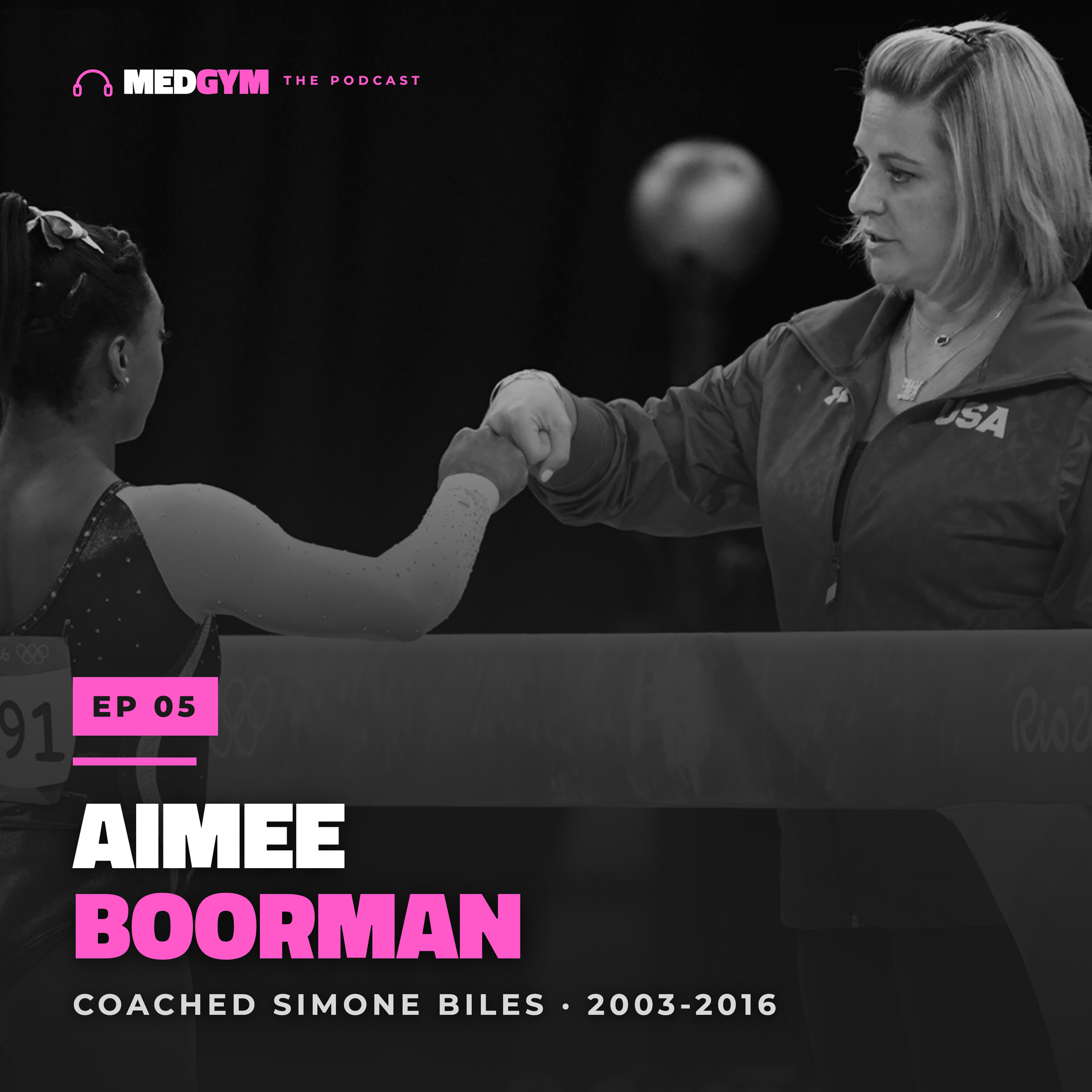
Gina Pongetti: Hello and welcome to the MedGym podcast. I'm Gina Pongetti Angeletti, physical therapist, and someone who has spent a career in the gap between what an athlete's body can do and what it's being asked to do. This show is about health in the sport across three pillars: mental, physical, and training. Every coach on the show gets the same question in a different form. How do you get the most out of an athlete without using her up? Today's guest answered it with the most decorated gymnast in history by doing less than everyone told her to. Aimee Boorman met Simone Biles in 2003 when Simone was six at Bannon's Gymnastics in Houston. She coached her for the next 13 years, three world all-around titles, four Olympic golds in Rio, on a schedule most elite coaches would have called way too light. And in 2025, she wrote it all down: The Balance, a book, with forward by Simone herself. Aimee, thank you so much for being a wonderful friend, a peer in the industry, and for being on the show. Welcome to the MedGym Podcast.
Aimee Boorman: Thank you for having me.
Gina Pongetti: So the balance. What's the whole athlete mean? What does that actually mean when you're talking about making sure that the athlete's heart and soul and home life and sleep and nutrition and everything comes together? we know what the result is, is that obviously your 13 years with Simone worked. tell me what a normal training week looked like for you and Simone. At fourteen first, and then let's get into maybe when she was just a little bit older. Numbers, hours, days off. How did you balance it all?
Aimee Boorman: Yeah, sure. mean, it's been a while. So when she was 14, I want to say, you know, she was probably training 20 hours a week. And I know that would blow most people away. And they think that she's superhuman and that's why she could do that. But honestly, she was a person first. and she had to go to school and she had to have her family life and she had to have her friendships and all of that. So all of that had to work into place. And most importantly, she was not separate from the rest of her team. So even though we knew that her trajectory would be very high and very quick, she still had to be a part of the team. And it wasn't until probably, I don't know, maybe around 16 that she started putting in some extra hours, but those were literally just flexibility, you know, and making sure that her, she was getting her PT in and making sure that her body was healthy so that those hours that she was putting into the gym were very efficient.
Gina Pongetti: So it wasn't just extra reps on routines and let's learn a new skill for three straight hours. It was calculated almost that the extra was to help take care of the rise.
Aimee Boorman: Correct, yeah, because we knew like if there was anything she was deficient in when she was starting to come up was her flexibility. know, the tightness behind the knees, the ankles, the toes, the refinement had to happen. And so it was never about
Gina Pongetti: Yeah.
Aimee Boorman: getting more numbers in or even doing more conditioning. Because as we can see, Simone's body type was very much, you know, suited for gymnastics, but also you can be muscular and not be strong. And so she had to learn how to use that muscle in the right way.
Gina Pongetti: Great point. We say that to our athletes all the time, that sometimes the look and the product are very different. You can also be a little bit more lithe as an athlete and be super strong given the events that you do, the skills that you're producing, et cetera. before Simone, you hadn't had a national team athlete. So you were learning at the same time as she was. how did that go with Simone? What did that let you do as a coach? because you were rising together that maybe somebody else that would have been in place didn't do. How is that experience maybe different?
Aimee Boorman: Well, I think that the biggest thing is that it can be very intimidating coming on as a new coach in that system, especially when there's been coaches that have been there for decades. a lot of younger coaches will look at those more seasoned coaches and say, well, they've done it that way for so long and they've gotten the results. But we're definitely seeing now that those ways that they got their athletes to those positions maybe weren't the healthiest. I just kind of took a leap of faith and I took what they were doing and what they were saying and I had to adapt it to what I knew would work for Simone.
Gina Pongetti: And if you had had four more athletes that were not Simone, but had different strengths and weaknesses, how would you have adapted to each one of those individually? Or how did you?
Aimee Boorman: I think I would have, yeah, I think that my training would have essentially stayed the same and the philosophy would have stayed the same, you know, that you're looking at a whole athlete, you know, what's the holistic approach. But if it was somebody where Simone didn't necessarily need to become more quick twitch per se, and I had an athlete that was maybe a little bit slower, then we would work on those things instead of the flexibility. Say I had an athlete that was more flexible, she wouldn't need the extra time on the flexibility, but it still wouldn't be doing, adding the hours to do the numbers. because the body just can't go on for that.
Gina Pongetti: That's very interesting. So if we were to talk for just a minute, we've talked to Jaycie we've talked to Amanda, who obviously were Olympians and turned coaches as well, about numbers in the gym, et cetera. just a 30-second shout to what an average beam workout would be in preps for a worlds or an Olympics. Where are your numbers? Are you doing total routines? Are you worried about hit percentages? Are you worried about in a rows? Just a little bit of a touch on that would be great.
Aimee Boorman: Yeah, I think that if I had to break it down, we didn't do in a two a day session, we wouldn't do more than three routines. And let's say on those three hit routines each session with maybe two full hard dismounts in those sessions. So the hit was what was most important. And if they got through that really quickly, then we would just work on the. the refinement, you know, or what was the problem skill, what was the problem connection. You know, you got through it, you made it. And this is the same training and philosophy I've done with my other gymnasts besides Simone, including when I've worked with international teams.
Gina Pongetti: Got it. I I think so many coaches ask at what point in time when you say, I need five hits and now they're at routine number sixteen. And we
Aimee Boorman: You
Gina Pongetti: have kids that come in and say, Well, my back hurts, and were you doing anything new? No. Okay, my hamstring hurts. You doing anything new? No. Well, you did 35 switch rings and you did so many dismounts that you landed short. At some point in time, that top number needs to have a top number and you need to just walk away from the day and say, Maybe we need to go back. to basics, maybe we just need a breath. How do you deal with that with the athlete when you know that you want the hits in a row for confidence and for consistency? but there has to be a ceiling because of leading to overuse. tell me your thoughts on that.
Aimee Boorman: Yeah, I would always frame it as you can hit three in a row or do five or make five, you know, or do seven. So you have three options here. Like our max is going to be, and I'm just throwing up arbitrary numbers there, but let's say if it's routines, okay, you're to hit three in a row. Okay. You didn't hit your three in a row. You have to hit five total. Didn't hit five total. Once you get to seven, we're done. And then we're going to pull out what
Gina Pongetti: Yeah, make yeah.
Aimee Boorman: Yeah, because like what was the error? If we're spending so much time trying to hit, hit, hit, hit, hit, and you keep missing, what do you keep missing? Is it a consistent skill you keep missing? Is it a specific combination? Is the assignment, you you had to stick the dismount every time and you got all the way to the dismount and took a step. Well, that's me being unreasonable as a coach if I expect you to get all the way through that, that seventh hit routine with no step on the dismount. You know, we have to have some reasonable expectations here. But I think also it gives the athletes kind of like when you give them that ceiling, it makes them more motivated because they're like, okay, well when I get here, I'm done. And I think that that's good. Or especially
Gina Pongetti: Absolutely.
Aimee Boorman: with a gymnast like Simone, where if I said hit three in a row, boom, three in a row. Not because she couldn't hit seven in a row. But if I said hit seven in a row, she's gonna fall on five before she hits the seven in a row.
Gina Pongetti: Right. Right.
Aimee Boorman: because she doesn't want to do that assignment. So that's part of the mental game of it.
Gina Pongetti: So that's the mental game. Each each athlete is a little bit different in that they need total numbers, and some athletes need to be in a row, and then they tell themselves that they're confidently done and it proves to them that they're doing it well as opposed to proving to you that they're doing it well, if if that kind of aligns. I think from an injury perspective as well, and I obviously You and I have talked a lot about this from a coaching perspective with many athletes of having diaries and saying, Well, what were you doing four weeks ago? What were you doing six weeks ago? When did you ramp up a new skill? When did you ramp up numbers? How important is it to you to keep not just to make plans for six, eight weeks, twelve weeks down the road, but to also just keep record of what you've done in the past to see what works year after year for someone like Simone that was on the national circuit for for many years in a row? But also just in case something's going wrong from an injury or a training perspective, what are your thoughts on notes, planning, and diaries?
Aimee Boorman: I think it's very important. With my athletes, I do individual lesson plans for each athlete and I do them on a generally a two to four week basis and it's kind of a rotational thing day by day and they're tracked every day so I can see what they're getting through, what they're not getting through. So on the next time that I'm writing the plan, I can go, okay, well they never completed this. This was too hard for them. So it doesn't matter how big I dream. Sometimes they simply can't do it. And so I know that that segment needs to not move forward. And I see that as a problem in a lot of coaches. Like they have this annual plan set in stone. And if I don't move from A to B, when it says to move from A to B, I'm never gonna get to the end goal. But the fact is, is maybe they need more time from A to B, but they're gonna go from D to E much quicker. And so I think it's really important to follow it.
Gina Pongetti: Which is which is just as bad having ha having this annual plan you want to push through is just
Aimee Boorman: Mm-hmm.
Gina Pongetti: as bad as having no plan. So adapting.
Aimee Boorman: Right, right. Yeah, because if you're not following the athlete because again the athletes are human and whatever they're going on with in school with their family life with a boyfriend Whatever it's that's all gonna have an effect on their training Are they getting enough sleep nutrition like you said earlier all of that stuff? So I do keep a Track of them throughout the year and I would say I do have my quarterly goals But they're more so goals and they're very adaptable based on what the athlete is giving me
Gina Pongetti: Right. I think follow the athlete, not the plan.
Aimee Boorman: Mm-hmm.
Gina Pongetti: have a plan, period. Then follow the athlete, not necessarily the plan. I think with rehab, we always say protocols are great. You can say someone's running at 12 weeks, you can say, Aimee, I think we're gonna return, you know, a little Josie to do switch leaps next week. But if it doesn't work, we have to follow
Aimee Boorman: Mm-hmm.
Gina Pongetti: what the athlete's body is telling us, not what we thought they were going to be doing. you definitely kept her hours lower than what the national program at that time and the leaders of the national
Aimee Boorman: You
Gina Pongetti: program at that time had expected. Who pushed back? what did you say to them? How did you handle saying, I I I know that we're not where you are, but it's working for us. Just wait. how did you handle that?
Aimee Boorman: I didn't really have too much pushback and honestly, like when she went from the 20 hours to probably 24 then 26, I think when she was training with me all the way up through the Olympics, the most we ever got to was 32 hours a week through the whole thing. So, but again, that was basic private lessons at some point, you know, where it got to be. And when you're doing those private lessons, you got to know when to pull back and just like breathe and take the time. but as far as the hours went, I think that when we bumped up and I could say, yes, we're doing four extra hours a week, but we're focusing on flexibility. That satisfied because, you know, with, with the powers that were at the time, it was clear what Simone was deficient in. you know, Marta could see that I was focusing on fixing the problem, you know. She knew she could tumble, she knew she could vault, she knew this, she knew that, but she didn't think that we would be able to improve in the flexibility department and the execution department.
Gina Pongetti: So when and when you say thirty two hours, you mean thirty two hours in a gym, not including PT, yoga, Pilates, any recovery, et cetera, t between twenty eight and thirty two s solid in the gym.
Aimee Boorman: Yeah, I mean, she didn't do much outside of the gym unless she had some PT. I mean, honestly, she was not. You know, nowadays with some of the athletes that I've worked with more recently, they'll spend 12 hours in strength and conditioning, separate from the strength and conditioning they do inside the gym, which, you know, I understand the value of it. I do think it's incredibly important, but also I think that they don't calculate that into their total hours sometimes. So I've worked with athletes who are in the gym 36 to 42 hours a week, and then they're adding that 12 hours on top. that's what I'm seeing more of in some countries who haven't quite adapted to the change of like what's healthy for our body as a whole. And how does this work? Because they're still stuck in the more is better. But you know, I was just listening to an interview with Aly Raisman today and she mentioned the thing about, okay, don't wanna misquote it, but it was, you have to find days to rest or your body will find it for you. And you know, that's exactly it. know, your body will just stop. It'll give up at some point. And so I think that that was one of the best things that we did with Simone was that that rest time was, it was scheduled in there because we didn't put too much on her plate.
Gina Pongetti: Right. I think the balance at that point in time for an athlete with notoriety, even a decade plus later now with social media, is also that your rest day needs to be a rest day. Just because you're not in the gym doesn't mean you can be flying to do a Nike ad or doing whatever. that's a body rest day, but that's not a holistic rest day. And that's which you talk about a little bit as we transition into the book. The title of your book. you know, is the actual philosophy. The balance is the title of the book. So if there was a club coach who might be an absolutely amazing coach who never has a Simone walking through their door and might not have the capabilities or the coaching bandwidth that you do, explain in a couple short sentences what you wanted to get across to people in the book.
Aimee Boorman: I think the biggest thing is just to put the whole person first. And it's not just the athlete, it's you as a coach. Because I know so many coaches who chase the dream. And I got to live what most people dream about. And I have no regrets about it. And I'm so grateful for it. But I had to make sure that I stayed balanced. And even in that balance, like my youngest, his birthday is at the beginning of October. And I missed three of his birthdays because I was in another country with Simone at world championships. he was young enough that he doesn't really remember that I wasn't there, but I'll never forget that I wasn't there. So when finding that balance, it was, okay, we did that. I was gone. But then when we came back, we took like a three week vacation together to kind of, you know, make up, I guess, for what was missed. But in my heart, was, it'll never be back. You know, I'll always
Gina Pongetti: Right.
Aimee Boorman: have missed those birthday parties. So it's, no matter what your goals and your aspirations are for you or your athlete, you have to look at the big picture. What happens when this is over? What if it's over tomorrow? And I think that taking care of yourself as a coach is really important because... You know, another side of this that I don't think gets talked about enough is that athletes switch gyms. They switch coaches. There may be a lead up and you know it's coming. Sometimes it's you don't know why and there's no closure to it. But then when that happens, there's like this sense of loss for you. And, you know, there isn't a coach out there who hasn't felt this at some point. And it could be even if they don't, maybe they just decide I don't want to do gymnastics anymore. You know, and you feel like, I sacrificed all of this for you. And it's very important from the coaching side that you never sacrifice more than you're willing to give up. You know, it's like being an investor. Never invest more money than you can lose.
Gina Pongetti: because it's not a quid pro quo, right? And that we go back to college where parents say to me all the time, We put so much time into P T and we put so much time into coaching and we did privates and we took her to all these camps and we can't get a scholarship. And I said, Well, it's not it's not like that. You put twenty five cents into a machine, you get a gumball, right? But you can
Aimee Boorman: Mm-hmm.
Gina Pongetti: put fifty thousand into gymnastics and you're not guaranteeing yourself a a a champion.
Aimee Boorman: You still get a gumball.
Gina Pongetti: You still you still you get a really fit body, some sleepless nights, a couple rips,
Aimee Boorman: Hahaha
Gina Pongetti: some Leos you gotta sell, and maybe you get something out of it. So I think I think learning that balance and I love that you focused on the coaches and all of the stakeholders within. there are so many people that it takes to get one athlete to whatever level that is, level eight through elite, through anything. including but not limited to, you know, parents, external family members that are driving, the coaches, the assistant coaches in the gym that have to pick up the slack when the head coach is out at Worlds or at nationals or at a World Cup event. And that does not go for naught. when coaches have to do some planning as to what their workouts are going to look like and put time in, but the time should be efficient and it should never be what is going to be resented on the back end, which I think is great. yeah.
Aimee Boorman: Right, right. And it's definitely a village, you know, it's when I think about it that I don't think that it would have worked without the support of Simone's parents, you know, that was very, very important. They were, they were all in, they were always on board. And if they had any, if there was any kind of discrepancy, we just talked about it and we worked it out and then that was it.
Gina Pongetti: Transitioning into the fact that support is wonderful, but no matter how much support you have, you also need rest and you need to go up and down. We're gonna mix science in just a little bit, because that's my realm, right? So periodization, right? periodization includes making plans within the actual workout for how tired you're gonna be four hours later, within a two-a-day, within a single week, within a week, within a month, within a three-month period. Within a season, we're not even done yet. Now we're gonna go within multiple seasons because often we all work our lives in quads. So I know there's a lot of people that work, you know, from August to May and know a school schedule. We all work in fours. and then obviously we're also looking at fours, eights, and twelves sometimes for people. So it's not just building a year, it's building a career. So You know, if a kid shows up that can already do what other 12 year olds can't and they're spicy and they're amazing and their skills are great, everyone could see what they could become. How do you slow it down the timeline? How do you talk to the parents and say, I know that you want to run the world tomorrow, but we have to look at this for the long haul. how do you pull back sometimes the importance of basics and the importance of of base strength building as opposed to just let's chuck a double?
Aimee Boorman: Mm-hmm. Well, you know, that was very, very important with Simone because she was too young for the 2012 Olympics. But had she been pushed faster, maybe she could have been in the running, you know, if we had capitalized on that earlier. But I also think that would have been the end of her. I think she would have, if she had made the 2012 Olympics, if she had been old enough and made the 2012 Olympics, she would have been done. because I think it would have been too much too fast. And I think the pacing that we had her on was just really important, keeping her little girl, keeping her having fun in the gym, keeping her making sure that she understood that, yeah, she could go and win these, you know, level eight, nine, 10 meets, but that wasn't gonna cut it at elite, you know? So let's take the time and very, very slowly figure out how you can start winning these elite meets. And I do think that that's an issue that a lot of young coaches have is they have a young talent and then they just, they go all in and everything is like, well, have to, she has to do a full in by the time she's 10 or nobody's going to look at her. And it's like, that's just not true. know,
Gina Pongetti: Right. Right.
Aimee Boorman: people, people really didn't know outside of Texas who Simone was until, I don't know, she was out of Texas doing elite.
Gina Pongetti: Right, right,
Aimee Boorman: I mean, honestly,
Gina Pongetti: right.
Aimee Boorman: like her first showing at Nationals, yeah, everybody talks about her floor routine, which was great, and her vault was really good for this tiny little thing, but the other two events were disastrous. Like literally, she got up on bars and like went handstand fall over, swing,
Gina Pongetti: Remember?
Aimee Boorman: cast handstand fall over like five times, I don't know, I don't even remember. It's
Gina Pongetti: Fall over.
Aimee Boorman: a blur. And then she goes to beam and falls twice. And although amazingly she fell twice. And I think she had an, and lost two tons in bonus with those falls. And she had an eight five with two falls and two tons lost in bonus. So that could have been a spectacular event.
Gina Pongetti: Right. Still im still impressive.
Aimee Boorman: .
Gina Pongetti: you took a very young, amazing Simone and said, Okay, calm down. We have we have a long term plan on how to do that. Have you ever had another kid, maybe not Simone, but but but a hot a little hot shot. that you had a conversation with a parent on and it didn't go well and they said, Well, we just want her to get better faster and you know, what happens in that case?
Aimee Boorman: I've actually been really lucky because I think that people have come to me because of my philosophy. You know, I guess I have had some that have been a little bit more pushy. well, she did this at level 10 and it's like, but not everybody's meant to be elite. So, you know, we can say, well, we'll try elite. And I think that's a mistake as well, because elite is called elite for a reason. You know, it is the best of the best. And just because you were great. at a certain level doesn't necessarily mean that you are automatically suited for that next level, you know, especially with the way the code of points is. I have, you know, I did have...
Gina Pongetti: And my shameless my shameless plug, Aimee, not to interrupt, is you're fine to step back also from Elite and to say to yourself, I don't think
Aimee Boorman: Yes.
Gina Pongetti: this is working. I would love to be the most stellar level 10 enjoy College. And it doesn't mean that you failed at something, but maybe your body wasn't there. Maybe you didn't have the highest level basics when you were younger. And fighting that uphill battle is difficult. And it's okay to step back. It's okay.
Aimee Boorman: Mm-hmm. Yeah. I mean, I had this other little... I'd like to consider her a phenom. She didn't start gymnastics until she was 10, I believe. And she went from being a level five to being an elite to qualifying for junior elite in three years. So from walking in the gym, starting in level five, to being a junior elite in three years. But hers was very different than Simone's. She didn't have the huge difficulty, but she had the... this gorgeous execution and gorgeous movements and stuff and just this incredible work ethic. And so it was also easy to guide her along that path. And I remember she wrote down her dream skills one day and one was a triple full on floor. when she, the day, I remember clearly the day she got the triple full on floor and how excited she was. And it's like, okay, well, what's next? And it was almost like she was like, I don't know. Like I got my dream skill. So like what do I do now? Because she had been in the gym so little. She'd only been in the gym for, you know, probably two, two and a half years at that point. You know, and
Gina Pongetti: Wow.
Aimee Boorman: yeah, yeah. And so it's just, I mean, that's the fun part of coaching and it's like, okay, well time to come up with a new dream skill or, know, what's your new goal? You qualified to junior elite. What's next? So, yeah, anyway, I forgot where we were on our.
Gina Pongetti: Yeah, you did it. What's next? Let's no, that's okay. We're
Aimee Boorman: Yep.
Gina Pongetti: we're gonna talk a little bit about a timeline. walk me through a buildup of a year toward a world in October. and where are you done learning? And at full skill difficulty in June, do you say, okay, we're done learning, now we're polishing, maybe we can add a minute of an upgrade in July? you can use Simone specifically, andor just in general, the other athletes, both in America and with other NGBs that you've worked with.
Aimee Boorman: Well, if you know for elite and the developmental program, it's very different because you
Gina Pongetti: Mm-hmm.
Aimee Boorman: know, there was one season in the developmental program and you know, some states have it at different times depending on their levels, the year doesn't start in January for gymnastics. I would say the year starts in December? November? December for elite gymnastics, I guess,
Gina Pongetti: Mm. Mm. Mm.
Aimee Boorman: because when you're coming back from Worlds, which would be your, generally, your goal for the year, you're gonna have some downtime. You're gonna take a little bit of vacation, stuff like that. And then you have to come back in and you got to start upgrading right away. You know, get back in shape. Hopefully you didn't get too out of shape while you took that little vacation. Then you're, starting your upgrades and then almost immediately you have to start doing your combinations and then you're building up into your parts because by March you have to be competition ready. Now you don't have to be a hundred percent competition ready. You know, that goal is not until October, but you do have to be, would say 70, 75 % if you want to make an assignment to go out for the US. And at that point, it's the balance between do I show and throw the new difficulty, although it might not be completely ready. Is it ready enough that it's safe, but we're still a little inconsistent? Then, okay, we might go ahead and do it, or least we're gonna show it. And then the decision will be made by the time you get into competition if it's gonna be put in a competitive routine.
Gina Pongetti: we've been talking a lot, just among medical peers about the concept of working backwards off a calendar and saying this is the goal and now we're gonna work backwards. And people say, yeah, we've got to we're gonna do this surgery, small surgery, she'll be back and ready in 12 weeks. I was like, No, no, no, the rehab is 12 weeks, then we need six weeks
Aimee Boorman: You
Gina Pongetti: to return skills, and then we need four weeks to put on soft, maybe two weeks to put on semi-hard mats, then two weeks. So now I mean we're do the math. and so working backwards with every athlete that I work with, we grab out that calendar and we say, what is your main goal? And if it was the perfect situation, when would you be absolutely ready? So maybe three weeks ahead of time, we're gonna put put like a this would be great. But if not ready until then, fine. And from there, it's when do you have to be full routine ready, hard surface, full routine ready, soft surface, full routine ready in pieces. Hard routine ready, all your pieces, all your parts, all your combos, et cetera. Aerobically, pounding wise, if it's a shoulder versus an ankle, it's different. but that's really important to walk through with the entire team, which is why having someone from a wellness perspective that understands the bigger picture and having a good relationship with the coaches is really important. Tell me how you did that with Simone, if and when she was ever struggling. with any of the injuries that she did with having to say, I think we can do this and take two weeks off or take two weeks lighter. Talk walk me through an instance that that may have happened.
Aimee Boorman: Well, you we were very, very fortunate and she stayed pretty healthy the whole time I was training her. You know, minor things here and there, a little rolled ankle. It was always to me when I look at the human body and let's say it's a rolled ankle, okay? I know that you putting in numbers on this rolled ankle are not going to help your gymnastics and are only going to continue to hurt your ankle. You know, like make the injury worse and hurt. which is going to affect your emotional state, it's going to affect your sleep, it's going to affect your stress level, all of the things. So we're just not going to do what puts pressure on the ankle until it's feeling better. You know, like you're going to do your PT if there's an assignment. So I used to have this big book of conditioning essentially. And what it was is I had all of these PT sheets in it. And I'm not a PT professional, but this is what I did in my gym with my lack of resources. I had all of these PT sheets. and I had all of this conditioning. so if they, if say there was an ankle section and someone had an ankle injury, they would go over and they would do the PT that was designated for them per their doctor, to, they would do that first. And then they would go to the conditioning sheet if they couldn't participate in what we were doing. Say we're doing a floor rotation, it's all tumbling that day, or they just simply can't be on the foot yet. They would go to the conditioning section and they would just not do the things that aggravated the ankle. They would do all of the other conditioning. you know, and then we would correct.
Gina Pongetti: As opposed to pushing through, having two weeks of pushing and then six more weeks off, you say that you were really lucky. I luck is one of my small pet peeve words You can you can mitigate
Aimee Boorman: Mm-hmm.
Gina Pongetti: injury, you can never prevent injury. but like you said, if you don't go too back, go don't go back too quickly. and you listen to what the athlete says about their body. I don't know that it's luck that the ankle sprains and the hamstring strains and everything didn't occur again. It's that we use science and advised
Aimee Boorman: sense?
Gina Pongetti: well and common sense and you listened and you listened to many people around you and took all of the advice in and said, What's best for my athlete? so sometimes it's not about luck is what I would say. And You should definitely be very proud of yourself for that instead of calling it luck that there might have been a little talent and planning in that, Miss Aimee.
Aimee Boorman: Okay, yeah, well, okay, so let me rephrase this. I feel that we were fortunate that we didn't have a lot of acute injuries. Is that a better way to phrase it? Better, okay. So, you know, and here's the thing that like...
Gina Pongetti: Better. I like it. Better. We put we put communication and science and listening and periodization and everything together and we'll call it whatever you want to call it.
Aimee Boorman: Yeah. And when her shoulder was bothering her, some days it was bothering her and some days it wasn't. When she would say it was bothering her or anything on her body that was bothering her, I'd be like, okay, we're not going to do it today. You know, we're going to skip that part today. And here's the thing that, that here's a pet peeve of mine with many, many coaches is, well, they're just trying to get out of something. So what? Let them get out of it. Does it
Gina Pongetti: Yeah. Yeah.
Aimee Boorman: hurt you as a coach that they didn't do a five minute handstand hold that day? No. It doesn't. And you know what? It's really not going to hurt them either. And if they keep...
Gina Pongetti: If they're trying to get out of going backwards on beam for like two weeks, you should probably notice that there's something psychologically going on that they're trying to get out of going. Or maybe they don't want to do gymnastics anymore or whatever. But if they're an elite, yeah. Yeah.
Aimee Boorman: Correct. That's exactly what I was going to say. Like, you've to look deeper. If it's the same excuse over and over again, you have to look deeper as a coach. Because that's like so irritating to me. Like, why do you care if a kid is trying to get out of something? The world's going to keep turning.
Gina Pongetti: Right. And and and look deeper into why.
Aimee Boorman: we're just talking about like having
Gina Pongetti: Go.
Aimee Boorman: the communication with the athletes and stuff. And one of my, I'd been coaching her for several years, probably, I don't know how many years, but, one of my teenagers comes in from school and this is a, this was a girl who is generally had a very light attitude, positive, friendly, everything. And she was just a mess. Like training wasn't going well. She was cranky, everything. And, and you know, Again, I think communication is so important and I was like, something's not right. And I was like, what is going on? Like, you are not yourself
Gina Pongetti: Yes.
Aimee Boorman: today. And she just bursts out crying and goes, I just have PMS! And screamed it in the gym and I loved it so much.
Gina Pongetti: Okay. Thanks for opening up.
Aimee Boorman: you can do today." And because, you know, she probably didn't want to come to gym that day, but she came. And she came and really, she just wanted to be left alone to do her thing. And I let her, but
Gina Pongetti: Send me a letter.
Aimee Boorman: because there was that she was comfortable telling me that and breaking down in front of me, she knew she was safe. And then I just let her do her thing and I checked in on her. And you know, and I think some other coaches might be like, that's not an excuse and get to work. You know, like, let's stop being such hard asses. It's really, you're going to have such, you're going to get better results. Right? Right. You're just, you're going to make bigger strides and
Gina Pongetti: Yeah. N no college scholarship was lost because of a Tuesday. Nobody Yeah. Yeah.
Aimee Boorman: by, by opening up.
Gina Pongetti: Right. I think the lightness of how how we are speaking in that you say, Well, let it go for that day or do this, that doesn't mean that people don't see the day in, day out of the commitment, which still has to be there. But when you have the commitment and when you have the buy-in from the athlete in the process, you get to have days where you say, Aimee, today my legs just
Aimee Boorman: Mm-hmm. Right.
Gina Pongetti: aren't doing it. And then you've you've I don't want to say you've bought that that poker chip. But because you try every day and because your body is used to training 99% of the time, you buy the ability to say to your body, today I just don't think it's o it's gonna work. And one day isn't isn't gonna break something. If it happens every other day, now we have an inconsistently trained athlete. And that's a completely different story. but you know, no one lost the Olympics or a scholarship on a Tuesday because of PMS. Note that.
Aimee Boorman: Okay.
Gina Pongetti: Okay, as Simone got bigger and stronger, we started doing bigger skills. And she did big skills that were pretty impressive with you. She did big skills that continued to be impressive after you. I wrote an article on it just about the risk reward situation of the that layer of fear when you start really doing triple doubles and and double doubles and some things that are that are scary.
Aimee Boorman: you .
Gina Pongetti: Where does that line stand for you? And this is both with a say you're coaching a personal athlete, even Simone, saying, I don't know that it's worth the risk. And then obviously as a judge, where does it stand for you where valuing something so high that has such a risk component to it is worth it?
Aimee Boorman: Yeah, I think that that comes down to numbers. You know, like the numbers you've put in to feel confident. you know, it's always that first or second turn that they're trying something I find to be the scariest, you know. And I know Simone has said this to me many times, other athletes have as well. But when they look at you and they say, I'm okay, right? Like I can do this, right? Like they need that affirmation from you because they believe it, but they just need that, that word from you and that's to me so much more powerful than a coach saying you have to do it. And I think that a strong personality like Simone, she ain't never doing anything that she doesn't want to do. She's just not, you know.
Gina Pongetti: Right. As opposed as opposed to well, in addition to her trust with you you know, very similar to coaches after you that were coaching
Aimee Boorman: Mm-hmm.
Gina Pongetti: her that said, I'm going to stand on this mat and I'm going to be here to spot you and we're going to take the deduction. Absolutely.
Aimee Boorman: Exactly. I'm going to take the deduction because she needs me there right now. And there will be a time when she doesn't need me there, but now she does and we
Gina Pongetti: Right.
Aimee Boorman: are okay with taking the deduction. And I think that that's great. And I think that that's wonderful. And, you know, there's I think if I had to pick one skill that we ever said probably not worth the risk was the Yurchenko triple on vault. And that was only because at that time they weren't allowed to touch warm up on the international stage. So that meant going from warming up on a non-podium surface to going and competing on a podium surface with no touch in between. And
Gina Pongetti: As much as those pieces of equipment and the equipment companies
Aimee Boorman: Yeah.
Gina Pongetti: try to make them feel the same, they are not. They're not.
Aimee Boorman: They're not, they're not. So, you know, that was the, we did end up abandoning that. Now she did stand up a few, you know, in a raised pit with a mat on top of it, you know, so competition height. She stood up a couple, but it still just came down to like, it wasn't worth it. I think the Yurtchenko double pike is far safer. And especially with her in her air sense, you know, like, When I first saw her do it, first heard that she was doing it when she first showed me the video, I was like, yeah, no problem, you got that.
Gina Pongetti: Well, the trust in the coach has to be there because
Aimee Boorman: I shouldn't be trying it.
Gina Pongetti: she'll ask you, Do you think I'm safe to do this? And your answer needs to be have with no bias to it making Aimee
Aimee Boorman: Mm-hmm.
Gina Pongetti: look good as a coach on the floor. Your answer has to be a true answer of yes, we are prepared,
Aimee Boorman: Yes or no.
Gina Pongetti: we've done the numbers and you're safe, or absolutely not, we're not ready yet, no matter how excited you are.
Aimee Boorman: Correct. Because wouldn't it look worse on Aimee if Aimee broke Simone because she was having her do a skill that... So like coaches that are worried about their ego, think about that when it comes to your ego. What's that going to do to your reputation if, you know,
Gina Pongetti: Right. Right.
Aimee Boorman: because that was always a thing, you know, am I going to be the coach who breaks her, you know? And so I had to balance that and I really had to trust myself in those decisions because I didn't really have anybody to lean on for that.
Gina Pongetti: Right? Of course. Well there hadn't been a Simone before, so all right, let's
Aimee Boorman: There had been Simones. They just left the sport before their time.
Gina Pongetti: Right, and and me mental stress and or like I always say the best. I have a bucket full of the best fourteen year old baseball pitchers I've ever seen in my life that will never do the MLB because of parent stress or expectations, mental load. How do you I get this asked all the time, and we have talked at length about this. How do you tell someone this is training soreness versus this is an injury soreness? how do you handle it? But then what's your advice toward other coaches?
Aimee Boorman: You know, I think that it first goes to the athlete, and again, if they're making a bigger deal out of it, then it ends up being, so what, fine, whatever. But I'd rather make a bigger deal out of it than a smaller deal. You know, like I would rather assume that there's an injury instead of it just being a soreness. I mean, like a soreness will come from a day of hard training. Usually most, well, if we're talking acute injuries, you usually feel that happen when it happens. But if you're talking about something, you know, like a
Gina Pongetti: Correct.
Aimee Boorman: spondy or, you know, anything that's a repetition injury, that's something that is going to creep on really slowly and then you have to take a little more time to evaluate it. But for me, I always go to the athlete first and then I'm watching them. I'm watching how they're favoring. I'm watching how they're punching or how they're grabbing or how they're pushing. And if I notice something that's really off, I start to go, that's more of an injury. Because like, and again, I'm not the professional you are, but if I'm looking at it from myself doing sports, and I'm sore, my shoulders are sore, and I'm playing volleyball, okay? My shoulders are sore. I can still go full range of motion and then I'm like, ow, afterward.
Gina Pongetti: Right, right.
Aimee Boorman: But if I can't go full range of motion, it's more likely it's injured. This is what my brain tells me. So I'm watching what the gymnast is doing and how they're managing their body.
Gina Pongetti: I think that conversation with the athlete is one of the most important things. The check-ins, the repetitive daily, even beginning of a workout to the end or beginning of an event to the end, and saying, I know that my plan for you is five today. Do you think your ankle can handle five today? And they say, Let's see. And there has to be a
Aimee Boorman: Or I say, check in at, let's check in at three. How are we at three? I'm good, I think
Gina Pongetti: Absolutely.
Aimee Boorman: I can do one more. Okay, or no, or I know what, you know, and again, with the communication, it has already opened up the, we're gonna try to do three, and they get to two and they're like, can't, can't do three. Okay, thank you, from the coaching perspective, you then, let's say you have that athlete, they've tried their routine twice, they've landed short on that last pass twice. You know, the assignments, three routines, make, not make, whatever. They do that third routine, but you say, okay, we're leaving out the last pass. After the routine is over, I want you to go over to the rod floor, rod floor onto the soft mat, rod floor into the pit, and I want one double tuck. You know, you're still getting your double tuck in there. They're still having to push when they're tired and they're discouraged, but now you're making it safe for them. Now, if they're injured, that's different, but if they're just off that day, just make it safer. You
Gina Pongetti: category, there's lots of options, right? You can vary landing surfaces, you can vary mats, you can do things. Tell me to your top three things that if someone is tired in the middle of a routine that is a way to still keep and push the purpose of the assignment, maybe mentally, maybe endurance, et cetera, without risking injury.
Aimee Boorman: You know, I like to, I don't do a lot of full floor routines necessarily in a week. Well, yeah, I guess trying to think of on my lesson plan how many I do full floor routines, maybe, maybe four full floor routines a week. Okay. So to me, that's a pretty low number, you know, on a, yeah, so, but
Gina Pongetti: You're talking about right before a performance event. So wanting to actually be on hard surface.
Aimee Boorman: right. But what I do is I will do routines where they have to do three switch leaps in place of the tumbling pass. Cause that has to generate power, speed, and they have to stay on rhythm. They may have to sprint to the corner and do two standing back tucks. They may have to sprint corner to corner. You know, like we do a lot that takes out the tumbling, or we may do a full dance through and then go to a soft landing and do all three passes afterward. So in that same minute and a half, two minutes, you're still getting everything you need in there. You're getting your explosiveness and keeping your artistry and all of that and getting your cardio in, but you're just protecting the body. And then when your fitness level is high enough and your passes are strong enough, it just goes together really easily. It's not a struggle.
Gina Pongetti: It's it's funny that you talk about how easy you say it like it's just easy because this is your your thing. But when
Aimee Boorman: you
Gina Pongetti: with for most of us, the most people who haven't been in the elite world, it's it's hard to to parse out training and pushing. I will go the opposite direction and say, now we're in a meet, and now is someone's really excited and they're tapping too hard for their Jaeger or they're blocking so hard. I remember and I think. many of us were there watching her in twenty sixteen and how one of her first vault timers was like a hoo you you almost were gonna flip off the mat, off the other side of the mat on to like we take
Aimee Boorman: You
Gina Pongetti: take a breath and calm down. So at any point in time because of Simone's power and because of where she was, how do you reel her in with the adrenaline and the excitement and just the energy that she has in in competition, not just the power that she has to do the skills themselves, but that adrenaline and competition excitement.
Aimee Boorman: Well, I think one thing that I really noticed from coaching her was her, she doesn't get like a huge buildup of adrenaline. I'm not sure if she does now as an adult, but as a child, if she could just stay like relaxed and playful and fun and talking to people until about the routine before. And then like, if you go back and watch videos of her, like right before she's up, she locks in. And I think that not having her lock in before that, and this was just something she created and I, I nurtured. But if I had tried to lock her in before that, I think her anxiety would have built. And having that anxiety would have built all of that extra adrenaline and the lack of control and everything. So that's from kind of a mental standpoint. From a physical standpoint, I used to have to tell her, like on floor, don't run. If you're tumbling, don't run. Like watch her old, I mean, yeah, when she's doing a triple double, she has to
Gina Pongetti: Right, she walks. Yeah.
Aimee Boorman: run. You know, she needs that speed, she needs that force. but watch her doing a double double. She can do it standing, you know? She can do it from a standing round off if she wants. And so you'll notice that she just kind of kind of gallops into it. And so that helps. Like with bars, yeah, watching her tap too hard on something, I'm like, I don't tell her to tap. I've actually never told her to tap. I tell her to hang. Just hang. Like you're so small and so quick, everything happens really fast. So like finding ways to slow her down was very important. And here's a good pointer, and I try to say this on every show interview I'm on, younger coaches, when you go to podium, you have to back up on the runway for vaults because every step travels further than it does on concrete. So when your athlete
Gina Pongetti: It sure does.
Aimee Boorman: is consistently overshooting the board, it's not because they're doing anything wrong, back them up. So like she knew that when we went to podium, she always had to start further back.
Gina Pongetti: as we go into mental health and training and coaching, we were all there. some of us were literally there for the whole entire process of the twisties and the mental side of Simone. you saw it leading up and you saw little bits and pieces to it. those of us that were obviously close to situation saw bits and pieces of it. It would get a little better, it would come back. so going into Tokyo in the 2020 Olympics that were delayed to 21. it was it it was not solved before we got on a plane. Let's just say that. what do you wish that every coach understood about the behind the scenes of how that was managed
Aimee Boorman: Yeah, you know, since I was there and I, but I only saw the, kind of the right before it happened. Like, and I talk
Gina Pongetti: Mm-hmm.
Aimee Boorman: about this in my book, that I could tell when she went to vault, her very first step was not normal. It wasn't her normal cadence. She didn't step with the same, you know, body movement. And I knew something was wrong immediately. And I was at the end of the vault runway. So like she was closest to me and I knew that something wasn't right. And, but I wasn't quite sure what it was until I talked to her that evening. And she said, I just have a really bad case of the twisties. So even though they had been like in our training groups, I hadn't noticed it because I was coaching other athletes. I was there coaching the Netherlands. So
Gina Pongetti: Great. Great.
Aimee Boorman: I hadn't noticed it. So the good thing was, The staff and her personal coaches were not making a big deal out of it because that just makes it worse. It wasn't made a big deal out of it. I think that they were trying to go back to another gym where there was nobody around to just allow her to fail safely and try to figure out where she was and try to let go of the stress and the pressure.
Gina Pongetti: I love that you say that, Aimee, the the fail safely, because that's exactly what what happened was no cameras, no press, no people. Just
Aimee Boorman: Mm-hmm.
Gina Pongetti: if you wanna try to chuck something and it doesn't go well, no one's going to watch it happen. and
Aimee Boorman: No one's gonna judge it.
Gina Pongetti: no one's going to judge it. No one's gonna write an article about it, no one's gonna say, my gosh, here's a leaked thing that I saw. when you're under the biggest spotlight you've ever been in in your life, I think was pivotal.
Aimee Boorman: Yeah, and you know, I think that after she competed Beam in the Beam finals and you know, her and Cecile have that moment, I don't know if anybody who hasn't gone through that truly understood what that moment was. You know, like it was, it brought tears to my eyes because I know what both of them were feeling in that moment and it had nothing to do with the fact how she did her routine. It was this obstacle that had to be overcome by both of them. You know, because Cecile and Laurent had a job to play, you know, they had a role to play in helping pull her through that as much as Simone had her own role to play. So, you know,
Gina Pongetti: Course.
Aimee Boorman: it was, it was just, it was really huge. And so whenever I see the photo of them together, right there with their heads together, it's, to me, that's as much of a pivotal moment in somebody's life as... the photo that I always talk about with Simone and I embracing at her third world championships when she won her third world championships. You know, like that's a moment. And I don't know if that was the moment for them, but I had that moment for them in that moment.
Gina Pongetti: Well, it's a it's a it's a still picture of what have we been through? What did it take? I'm so proud of you. I was a little bit nervous too. I did trust you, but I was questioning it a little, but I didn't want to let you know I was question. I mean, there's so there's so much that goes Yes, absolutely. And it was just
Aimee Boorman: Yes. And they both have those exact words.
Gina Pongetti: a smile and a hug and the everyone just going, huh? So did you see, did you ever see any of that? Four years earlier, did you ever see that with her or had the pressure built so much leading up to Tokyo and then obviously to Paris that things just were a bit of a different bird?
Aimee Boorman: Yeah, no, she, we went through the same thing. It just, we went through it in January before the Rio Olympics. So we had a lot more time. Yeah, we had
Gina Pongetti: Better time. Yeah.
Aimee Boorman: a lot more time to like, okay, whatever's freaking you out, we're not gonna do, you know? And we had time to do more therapy appointments and try to figure out what the root of all of it was. And, you know, I don't, I can't say that the root was ever figured out, but just the talk therapy worked. for everybody that was involved, her whole village became a part of it and there was no pressure from anyone. And I think that that helped, you know, or at least to my knowledge, there was no pressure from anyone. And I think that
Gina Pongetti: Right.
Aimee Boorman: that helped. But again, we had the luxury of time. And I don't think that, you know, Laurent and Cecile didn't have that luxury. It showed up, know, it reared its ugly head right then and there. And, you know, even if it had been happening before they left Houston, it's still was a very, very small window.
Gina Pongetti: What are three things that you would never ever say that a coach should say to a kid that's scared of a skill?
Aimee Boorman: Just do it. I would never say that.
Gina Pongetti: Right? Great.
Aimee Boorman: you're letting me down or you're
Gina Pongetti: Mm-hmm.
Aimee Boorman: disappointing somebody. I guess kind of the same thing that would fall into that would be that people are counting on you. it's hard for me to think of the wrong things to say because I'm always trying to think of the right things to say. I've heard coaches say, I've sacrificed so much for you. You have to get out there and do that. And it's like, you know, the fact that, that Simone was able to pull herself out of the competition, I just think says so much for her personal strength. You know?
Gina Pongetti: 100%. And the trust that she had in herself to know
Aimee Boorman: Mm-hmm.
Gina Pongetti: when it was time to say. And the conversations with Cecile and Laurent and the conversations she had with you and medical staff and and just to say, I I I'm not doing this for anybody else. I think this is the best decision for me. And I need to be done today. Just today. She needed to be done today.
Aimee Boorman: Yeah. And I'm still very, very angry, very, very angry when people say like that she just couldn't handle the pressure because, you know, that woman has faced more pressure than people can even imagine, you know, like those, those armchair quarterbacks, those armchair gymnasts and coaches, you know, who only watch gymnastics once every four years for two weeks, you know, shut up.
Gina Pongetti: in wrapping, my last question, you know, the state of the sport currently. You've coached essentially every level of the sport. There's developmental gymnastics, there's elite gymnastics, and then there's the coach that can take the same athlete from one to the other. And those are three very separate skill sets that some people are great inheritors where they get the already the kids that already have all the things. Some love the fight in the beginning of creating and then some can take from young and you've done all of them. what has gymnastics gotten right in the last ten years and what still worries you?
Aimee Boorman: So I think that the overseeing bodies in gymnastics, at least in USA gymnastics, are really starting to focus on the athlete and making sure that the athlete is good and right. so that's the biggest thing. I hope that Simone and I paved a bit of the way for that, you know, and showing that she still is like, maybe I'll come back, maybe I won't, you know, and if she... chooses to come back, she's probably gonna come home with more medals, you know, like, and so her longevity in it shows a lot. Things that, what are they still not getting right? Yeah.
Gina Pongetti: And it might not be the the NGB. What is the the sport as a whole, from skills to judging to code of points to the the Olympics? I mean, we could talk about the two per country rule. You know, what what what are we still what still worries you?
Aimee Boorman: I'm gonna steal one from Simone, which is kind of... but she
Gina Pongetti: Yeah.
Aimee Boorman: said this the other day, I think. She was like, if she could get rid of any rule in gymnastics, it would be the tie. You know, like, if you tie,
Gina Pongetti: yeah. Yep. The tie.
Aimee Boorman: you should both get a medal. Agreed. But,
Gina Pongetti: Yes, just everyone just needs to be happy.
Aimee Boorman: Yeah, you know, I wanna take a second to think about this, because I know that being in the sport my whole life, I've... griped about things and then things have gotten better and then I've griped about things, things have gotten better. And sometimes they're just my mini gripes and sometimes... You know, one thing that would be interesting, I'm a judge and a lot of people ask for more transparency in the judging. And I agree and disagree with this. If there could be a way, like I don't think that judges would feel safe to be transparent. with the general public about why, about why they gave a score. Not that they don't believe in why they gave a score, but they don't want the ridicule. They're like, that's not why I do this. I don't do this to be attacked by people. So if there would be a way to improve
Gina Pongetti: Course.
Aimee Boorman: on finding a balance between, and an understanding of why things are scored the way they're scored, because I think the public feels like they're just told, well, it's scored that way because that's what we decided to do. But it's not that, it's very complicated, it's very difficult. So, you know, I wouldn't be opposed to finding some way like figure
Gina Pongetti: I th I think that's very
Aimee Boorman: skating does, you know, where they follow along and,
Gina Pongetti: Yes, I was just gonna say a little yeah.
Aimee Boorman: yeah, at least so people understand what the difficulty score is and what was awarded as the routine is going because they do that in skating, correct?
Gina Pongetti: they do. We do it in skating. Right. It's very complicated. Right.
Aimee Boorman: And we only see it in the blink of an eye. You know, like it happens very quickly and we have to make that judgment right away. The other thing that I think that we still need a little bit of work on is training our younger coaches that, okay, so when you have a really good young athlete, educate the coach. It's not necessarily about how much can we push that athlete to be great. And that coach has to understand that their job is not to push that athlete to be great. It's to learn how to continue to produce. So the US is continuing to produce, but doing it with that holistic approach because there's still too many overzealous
Gina Pongetti: I agree.
Aimee Boorman: young coaches who just think that I got to push harder and faster at all costs in order to get an Olympian.
Gina Pongetti: I know that Betty and Chelsea value that a lot. personally I know that, but they I think it can always be better. And I think that that if you have a really good athlete, don't let the coach's excitement and lack of education. It's not stupidity, it's ignorance, right? There's a big difference in in just not knowing because it's the first time you're on the big stage. And I think that is is incredibly important. Well, thanks, Aimee. I'm sure if you thought for another 10 minutes, you'd think of all kinds of other things to change the world. But we really appreciate it.
Aimee Boorman: Well, I do want to say one really good thing, though. I have seen since, you know, I haven't been in the USA program deep besides judging since I stopped coaching Simone. I have seen some really, really wonderful young coaches come up that have brought their athletes from their developmental programs into the elite world. So there are more coaches that are straddling that and seeing how to do it and how to do it. healthy and how to do it successfully.
Gina Pongetti: And I will add to that, if the coaches are doing it successfully, mentor someone at your gym that wants to. And if you don't feel like you're getting that mentorship at your gym and you are willing to put the time in, find someone that can. It doesn't mean leaving your job. It can mean doing mentorship on the side as well. but if you really have a dream to coach and to be better, being next to someone that has walked the walk is is important. So well, thank you, Aimee.
Aimee Boorman: Absolutely.
Gina Pongetti: what I'll take out of this is that the most dominant athlete in this that the sport has ever seen was built on
Aimee Boorman: You
Gina Pongetti: less, fewer hours, a little bit more rest, and a coach who kept asking her what she thought. where can people find you now? On social, or what are you doing in life? Are you for hire? What's the what's life for you?
Aimee Boorman: I am currently living in Arizona and I am, yeah, I'm available. I'm not working at a gym full time, so I'm available. I judge, I coach, I mentor, I do whatever. I do public speaking. So, yeah.
Gina Pongetti: May I say that some of the best money that you can spend if you are a coach is to put put a dollar limit, put a time limit on it and say, mentor me and just walk through what you're doing and use Aimee's resources and the understanding of being a gymnast and being a coach and being on the world stage and being a judge and just having that mentorship that can be very fluid in what you're asking at what time of year. Am I doing these plans right? Would you change periodization? she is a a wealth of knowledge of breadth and depth and not that she also wouldn't be a fantastic coach to an athlete rising but mentoring other coaches you know is is super fun so thank you Aimee
Aimee Boorman: Absolutely.
Gina Pongetti: that is our show today one thing to carry out of today if a program can't tell you when its athletes rest it doesn't have a plan it has a schedule New episodes of the MedGym podcast come out every other week with some bonuses. Every episode, the show notes and our practitioner directory are at medgym.net. Follow the show wherever you are listening. And if it was useful, send it to a coach or a parent or an athlete that needs it. Thank you, Aimee, for being an amazing peer, more importantly, an amazing friend. And here's to a fabulous future in the sport. I'm Gina Pongetti Angeletti. Take care of the athlete, not just the routine. Prevent, treat, perform, and we will see you next time. Have a great day.